
Scottish Art News
Latest news
Magazine
News & Press
Publications
TUA MAK at Tramway: Rae-Yen Song Turns Ancestral Memory into Immersive Art
By Lena Kammerer, 08.12.2025
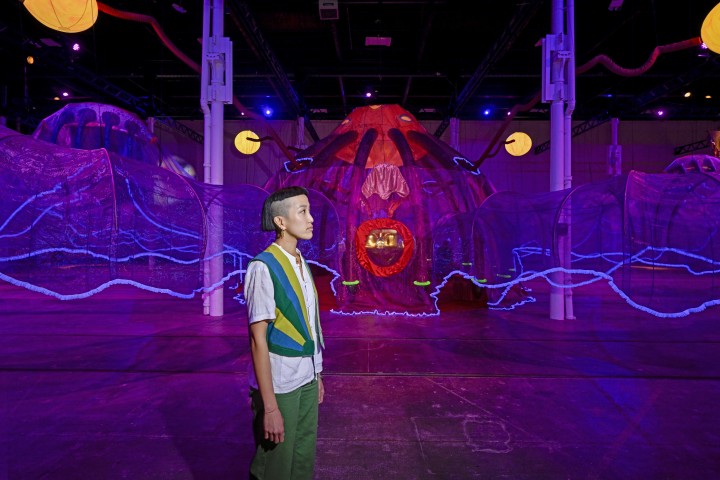
By stepping into the vast gallery space of Glasgow’s acclaimed arts centre, Tramway, visitors are immediately enveloped by a mesmerising sub-aquatic world conceived of by multidisciplinary Glasgow-based artist Rae-Yen Song. Sprawling outward from a central core that holds the aquatic culture from the Song family pond in Edinburgh, encircled by various sculptural offerings, eight tentacles of an expansive, ethereal creature unfurl into tunnel-like walkways of luminescent fabric. At the tip of each tentacle, an ancestral character from Song’s visual mythology peers down onto mouth-blown glass sculptures propped on plinths, their centres flickering alive with animations.
Surrounding this, a constantly shifting interplay of light and sound, controlled by the microscopic lifeforms inhabiting the pond, amplifies the work’s entrancing, phantasmagoric presence while sculptural costumes float through the space at varying heights, waiting to be used for performances throughout the run of the exhibition. For Song, the installation, structured by the ancestral logics of the Song family, is less a static artwork than an environment with its own ever-evolving presence: “The installation becomes this living ecosystem. It’s an architecture of this micro-beast that floats in the space, this deep abyss, in which audiences become microscopic themselves and are moved within the body. They move through the tentacles and become a part of it; they breathe with it.”
While the Tramway exhibition is billed as the artist’s most ambitious solo exhibition to date, Song, who holds a BA (Hons) in Sculpture and Environmental Art from Glasgow School of Art, has featured in multiple significant exhibitions across the UK, including CCA Glasgow last year and Dundee Contemporary Arts in 2022. This most recent exhibition showcases yet another fascinating iteration of this “ever-evolving exercise in world-building,” which Song describes as emerging from “an ongoing porous practice”.
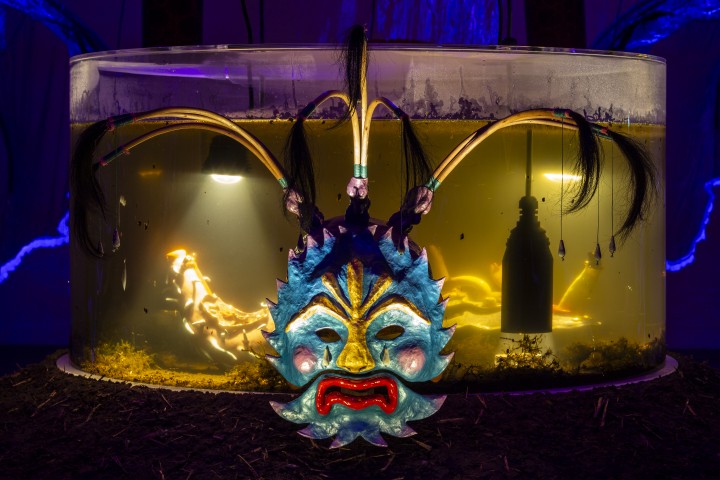 A glowing tank forms part of the central ecosystem within Rae-Yen Song’s TUA MAK installation at Tramway.
“It’s a process of tending to ideas and characters, a cosmology and these different ecosystems that are all continuously growing and shedding, composting and renewing across time, across projects, across spaces,” says Song. “None of it, I claim to have finished. Nothing is built at once, and everything is continuously reshaping, remoulding, resurfacing.”
Personal ancestral mythologies and histories are instrumental elements shaping this continuous process of world-making. Song explains; “this idea of ancestral memory and myth, first of all, starts with stories, which are often oral and they’re nonlinear. They’re very slippy in the way that they live from memories, which are misremembered and re-remembered and from that, myths grow in this space of slippages. I use fabulation. I use materials and this kind of ritual of crafting to fill in those gaps left by migration and rupture.”
The Tramway exhibition’s title-giving, central figure is tua mak (大眼; “big eyes” in the Teochew dialect), one of Song’s ancestors, whose tragic story of drowning at sea in Singapore at just thirteen years old has been relayed through such familial oral histories and is embodied through the built elements of the creature that fills Tramway’s gallery space.
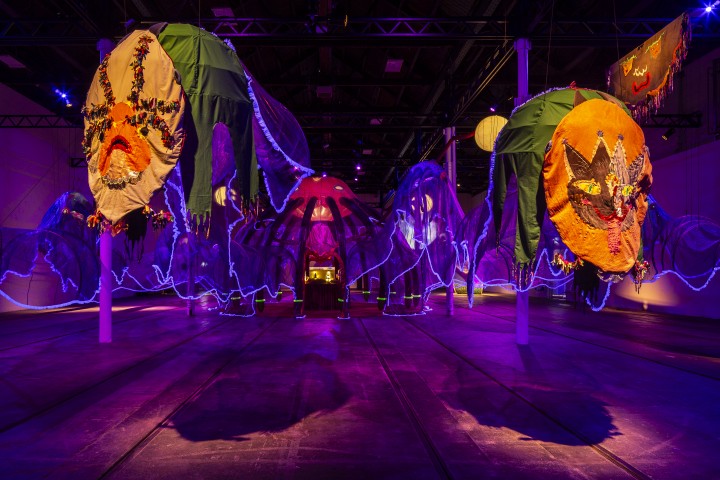 Suspended mask figures in Rae-Yen Song’s TUA MAK at Tramway.
But Song’s practice, informed by Daoist philosophies, also extends further into the more-than-human politics and explores the intertwining of past, present and future. tua mak is envisioned as a dispersed lifeform, its watery decomposition resulting in its persistence as different elemental matter through its consumption by others, becoming a persisting presence in continuous motion, migration and transformation. “tua mak died in water, but water becomes cloud, becomes rain, it becomes pond life. I think of the family pond that’s in the centre as heart, as brain, as energy of tua mak. I think of it as a shrine where all these microorganisms and pond life are living in there. They act as kin. They are controlling the sound and the light constantly. It’s the sound and light and micromotion that are feeding one another. In that sense, this body of water connects this sense of grief with regeneration.” Song adds, “I’m very much interested in expanding what ancestor might mean, and it’s moving beyond these ideas of lineage but more towards an ecological sense.”
Spanning countless mediums, with the current exhibition at Tramway showcasing a diverse range of newly commissioned works, many of which were created or will be used in collaboration with family and other artists, Song’s immersive world-building appears, ultimately, inseparable from the very act of living. “I see myself, first and foremost, as a maker. Not in any particular medium, but as someone who wants to make things exist with my hands. It’s very intuitive, there is a material curiosity and a resourcefulness of what I can get my hands on and what feels right for the idea or the kind of thing I want to create. I’m not interested in making art objects, things that are static. I’m much more interested in making things that are instruments or tools or shelters or vessels or costumes. All of those things are everyday living things, things that we use to live. They’re forms that hold energy. They have warmth, or they warm us. They are vessels for dreams and fluids. These are things that predate the kind of ideas of the category or the word of art. They’re things of life, and that’s what I want to make.”
•~TUA~• 大眼 •~MAK~• by Rae-Yen Song is exhibited at Tramway, Glasgow until 16th August 2026


