
Scottish Art News
Latest news
Magazine
News & Press
Publications
Michael Fullerton Q&A: Asylum Seeker Portraits in City Art Centre Exhibition
By Greg Thomas, 23.02.2026
.jpg)
Michael Fullerton (b. 1971) is a Bellshill-born artist whose work incorporates painting, printmaking, installation, and sculpture. A product of Glasgow Art School (GSA) in the 1990s, his career reflects both the 1990s post-conceptual art boom in which GSA was a key player and the influence of an older set of figurative and expressionist painters, including the New Glasgow Boys.
Fullerton is most celebrated for his portraiture, often based on photographs, which combines the Rococo lightness of Thomas Gainsborough with elements of Post-Impressionist and Expressionist painterliness. Much of Fullerton’s work is concerned with recovering forgotten, maligned, or misunderstood figures from history and politics. This is particularly true of his silkscreen portraits, which often involve reproducing found photographs on newsprint.
Fullerton’s current show at Edinburgh’s City Art Centre includes a new set of portrait paintings depicting residents of the Hilltop Hotel in Carlisle, where the artist lived and worked for five months in 2023 while it was being used to house asylum seekers. The exhibition, which runs until 12 April 2026, also includes a survey of 20 years’ worth of screen-printing. Greg Thomas caught up with Fullerton in his Blantyre home.
GT: How did the idea for the current exhibition come about?
MF: Well, when City Art Centre approached me to do a show, they told me there were two floors to fill. So I proposed to make new work for one floor, and compile an archive of my prints for the other. My photos of migrants were already in the bag at this point, although I hadn’t yet made the portraits from them, and I was just looking for a venue.
.jpg) Michael Fullerton, Murtaza (Iraq), Asylum Seeker, Hilltop Hotel, Carlisle, 2025, oil on linen. Courtesy the artist
Michael Fullerton, Murtaza (Iraq), Asylum Seeker, Hilltop Hotel, Carlisle, 2025, oil on linen. Courtesy the artist
GT: How did you end up working with, and painting, people seeking asylum in Carlisle back in 2023?
MF: I’d been living up north for a few years, working with my nephew in a hotel that he ran. And then I found out that the company that owned that place had another hotel in Carlisle. I knew about it from news stories about anti-migrant protests, and I decided I wanted to see it for myself, to get behind the headlines. So I transferred there.
I started as a general assistant, but I ended up mainly cooking in the kitchen and serving food. That’s how I got to know the people there, just through conversations at mealtimes. I was living in a room alongside everyone else, because it was a live-in position. Initially I didn’t want any of them to know I was an artist - I didn’t want to hassle folk. But eventually I showed a couple of them a book of my work, and I just started photographing them.
I only asked a couple of the guys if I could take their photo - there were 150 in the hotel, all men. But they told all the other guys. So, I ended up with about 28 portraits, done from the photographs I took. I set up this almost formal photography studio in an unused ballroom and I had boys queueing out the door!
There’s thirteen pieces in the show and each one shows someone from a different country: Afghanistan, Iran, Eritrea, Syria, Kurdistan, Iran, Somalia...But I’ve got about 50 photographs in total—enough there for another show.
.jpg) Michael Fullerton, Joma Ahmadi (Afghanistan), Asylum Seeker, Hilltop Hotel, Carlisle, 2025, oil on linen. Courtesy the artist
Michael Fullerton, Joma Ahmadi (Afghanistan), Asylum Seeker, Hilltop Hotel, Carlisle, 2025, oil on linen. Courtesy the artist
GT: You talked about wanting to get behind the headlines, and I feel like this is a common theme in your work, celebrating or exploring figures who have been misrepresented. Was there a polemical impetus to portraying these asylum seekers in that sense?
MF: Oh, definitely. I wanted to see the place for myself because I knew all the discourse surrounding it, and it had affected me to some extent. I was nervous. I didn’t know what to expect. Just before I got there there’d been a protest on the roof over conditions. But when I got there the guys turned out to be alright.
Back in the day, I used to make paintings of people that I really liked and looked up to—it was like a fan club-type art, you know? Whereas as I got a bit older, I became more interested in people whose identity is contested in some way. I was attracted to the migrants for that reason. But I didn't go in there with an agenda, either pro-migrant or anti-migrant.
I was actually kind of inspired by Ansel Adams, the American landscape photographer. During the Second World War [1943-44] he went to the Manzanar Relocation Centre, where they rounded up all the Japanese-Americans and put them in detention. He went there and photographed them, and the photographs are fascinating because normally his photographs are very romantic but these are quite formal, documentary. It’s as though he was trying not to impose an aesthetic on his subjects, and I was quite struck by that.
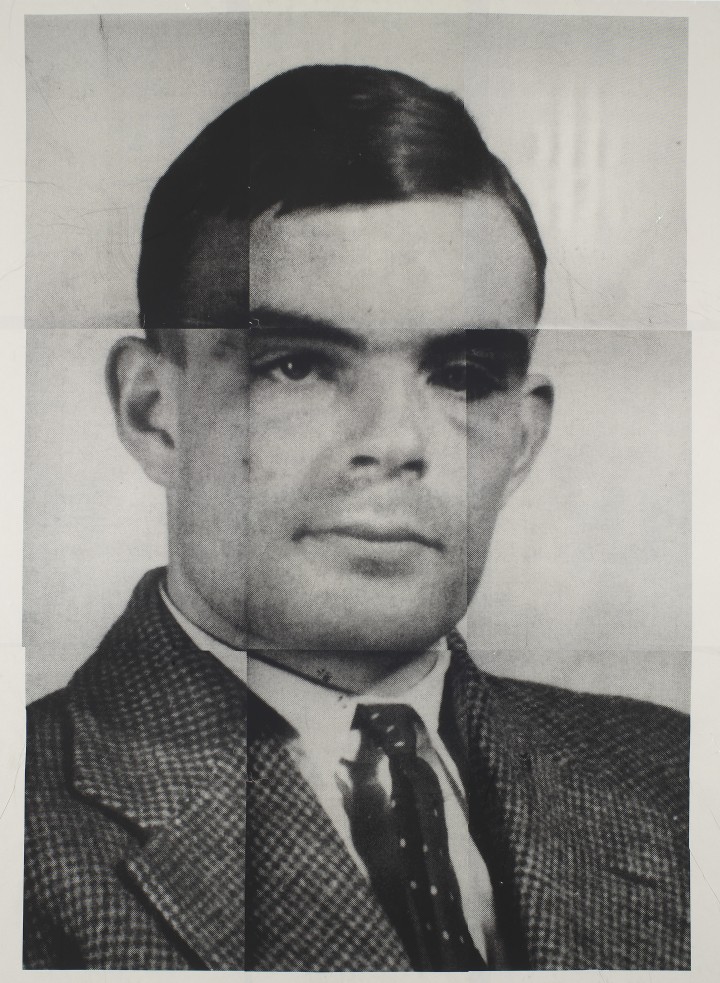 Michael Fullerton, Using Polish Technology, Turing Devised a More Sophisticated Machine to Crack ENIGMA, 2010, screenprint on newsprint. Courtesy the artist
The other thing that inspired the work was George Orwell. Back in the 1990s there was an exhibition of Orwell’s notebooks, typewriter, and that sort of stuff, while I was at art school. And it always stayed with me, the idea of his commitment to realism, actually going down to the coal seam when he was writing The Road To Wigan Pier [1937]. That was in the back of my mind as well.
GT: What about your screenprints? What made you want to group them all together in this show?
MF: I had a lot of prints, including really large-format prints, in my studio that I hadn’t had the chance to get out for 15 years. A lot of these pieces have only been seen once. There’s a mixture of screenprints on newsprint and framed works on archival paper. The newsprint works are fly-posted directly onto the gallery walls – it’s modelled on Bolshevik posters and political fly-posting – so it will have to be scraped off once the show is finished. I find it interesting that some of my work is destroyed like this, and other pieces are designed to be preserved. It has something to do with the private and public roles of painting and screen- printing respectively.
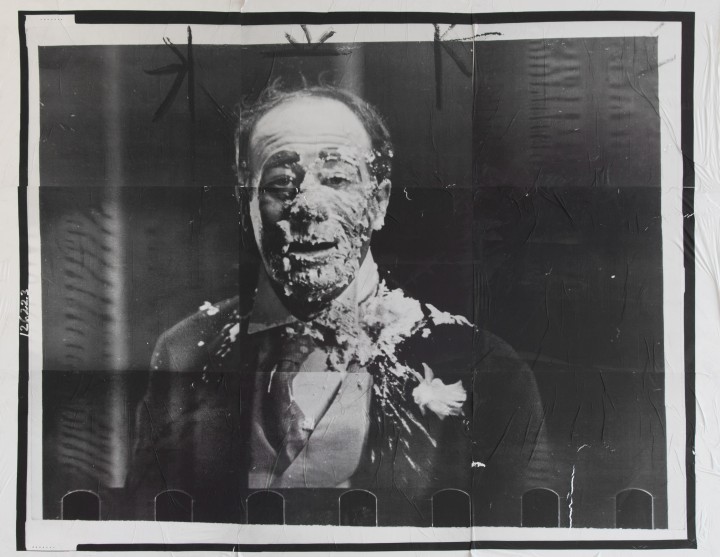 Michael Fullerton, Painter (Bert Lahr 1934), 2014, screenprint on newsprint
GT: Your screenprints are more likely to use images in the public domain, often of well- known and perhaps misunderstood or mistreated figures, such as Alan Turing. Who are some of the figures represented in the show?
MF: Turing is in there [Alan Turing, 2010]. There’s a print of Bert Lahr, who played the lion in the Wizard of Oz, with cake all over him. That work is called Painter [2014] and it’s kind of about the pathos and tragedy of being an artist. And, although it’s not fly-posted, there’s a print of Kim Dotcom [Ultramarine, 2014], who was an internet hacker in the 1990s. I went to visit him when he was under house arrest in New Zealand, and took photographs of him.
GT: The unfairly prosecuted or ostracised individual is a key figure in your art isn’t it, as with your portrait of Paddy Joe Hill [2003], one of the Birmingham Six wrongly imprisoned for a pub bombing?
MF: Yeah, definitely. For my MFA degree show I painted Lady Hazel Cosgrove [Lover, 2002- 03], the first female high court judge in Scotland. That was really my first foray into the judicial system. I became really interested in how people are defined under the law, in ways that can misrepresent them or leave them in limbo.
That kind of takes us back to the asylum seekers. When you paint people in these situations, they’re obviously human beings and you bring a humanist value to the work. But there’s also this legal or political dimension to their identity, which is attached to them, or there in the background. Sometimes people’s personal identities can be warped by these other aspects of their identity, because of how they’re discussed in the media, say. Part of what my portraiture is about is elevating people like this, rather than the landed gentry someone like Gainsborough had to paint.
Michael Fullerton is exhibited at City Art Centre, Edinburgh until 12th April, tickets £5.


