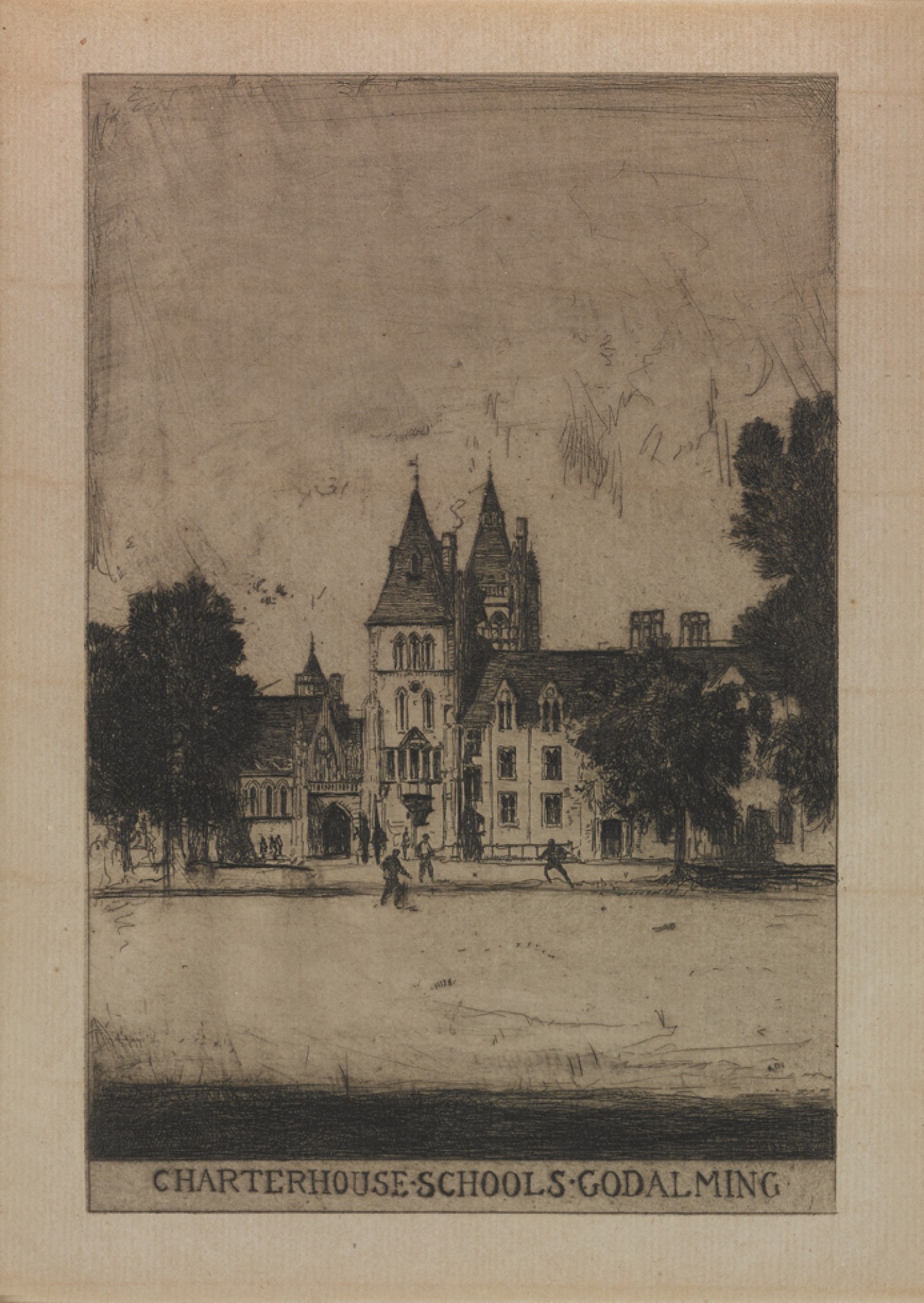
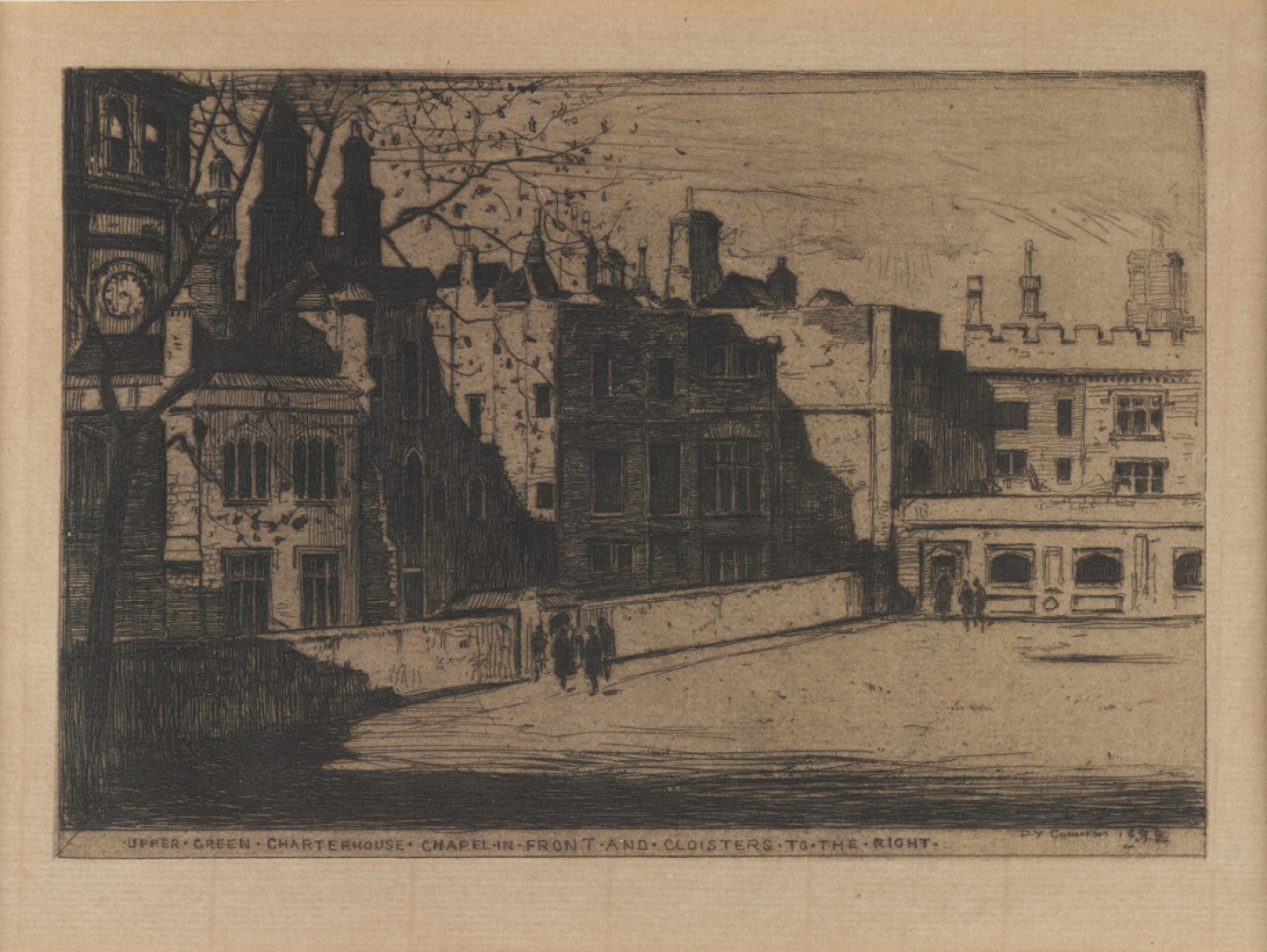
Charterhouse Chapel in Front, Cloisers to the right
David Young Cameron


DESCRIPTION
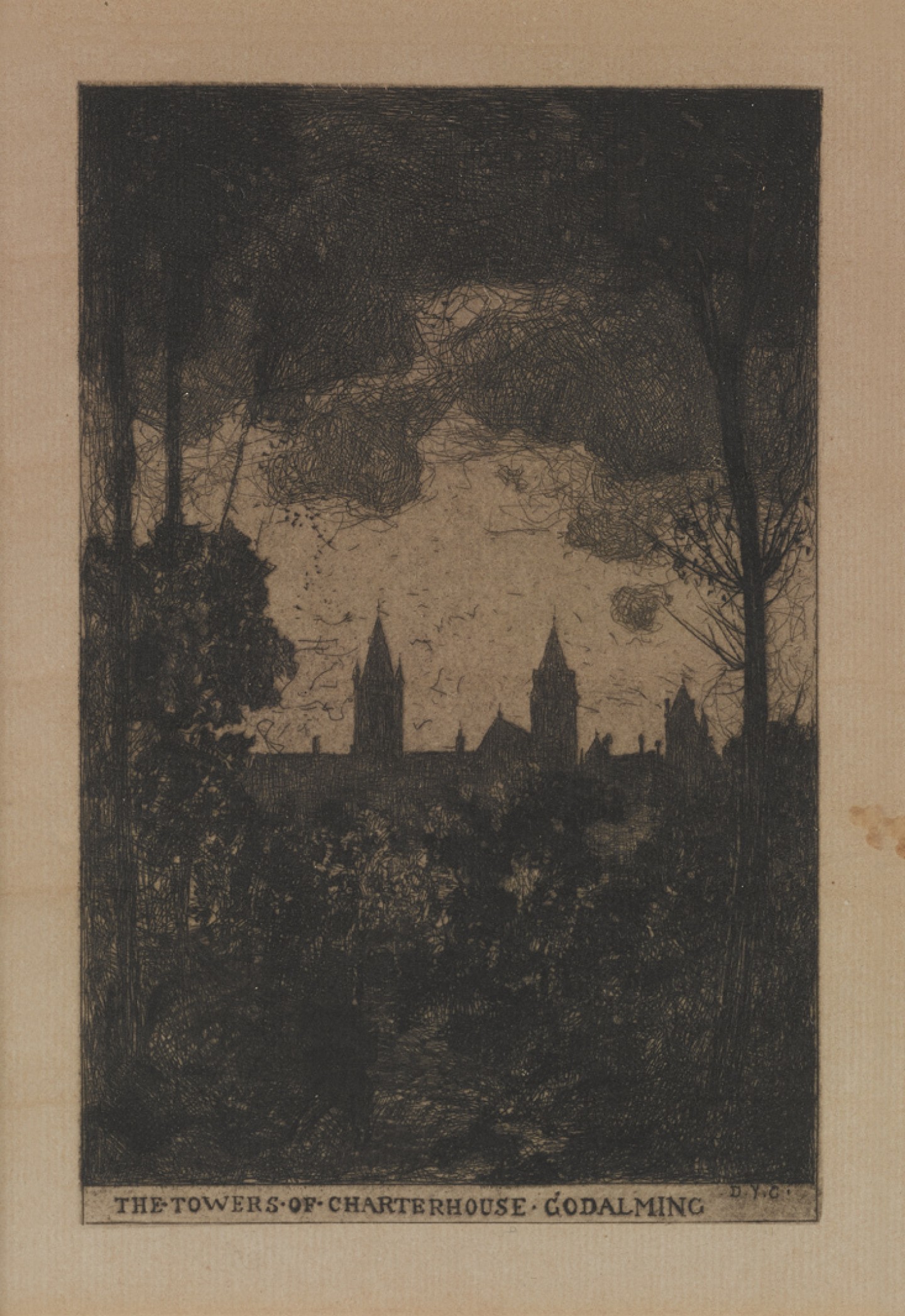
Charterhouse Chapel in Front, Cloisters to the right by David Young Cameron (1865-1945) is part of a series of prints depicting the Charterhouse school of Godalming and is a black and white etching that captures a view of the school's chapel and cloisters with a tree in the left foreground and two groups of figures entering the chapel and cloisters. Cameron combines his interest in architecture and his skillsets in etching and shade work to capture the elaborate architectural details of the Charterhouse school. Varying thickness and spacing in the linework creates depth to the buildings. The layering of these thick lines creates the overall darker composition of the towers in the background, which creates perspective in the overall work. The more irregular and less controlled lines in the tree's branches and leaves contrasts the refined and straight lines of the buildings to show Cameron's attention to detail throughout the work.
Cameron rose to prominence through his etching skills, with this series of work representing his strong skills in printmaking through the use of light and dark contrast. Through the 'Etching Revival' spanning 1880-1930, Cameron produced and sold many of his prints through the support of art dealers in Glasgow and Edinburgh. Many of Cameron's etchings captured architectural fixtures in immense detail, reflective of his developed skillset and attention to detail. The Charterhouse School was a subject of many of Cameron's prints throughout 1894-1895, reflective of his time spent during this period capturing the architecture of many schools and chapels.
DETAILS
-
Artist
David Young Cameron
-
Date
Unknown
-
Medium
Print
-
Object number
3203
-
Dimensions unframed
11.5 × 15 cm
-
Dimensions framed
58 × 43 × 1.5 cm
-
Marks
Signed and dated bottom right
-
Subject
ARTIST PROFILE
Sir David Young Cameron RA RSA RWS RSW, 1865-1945
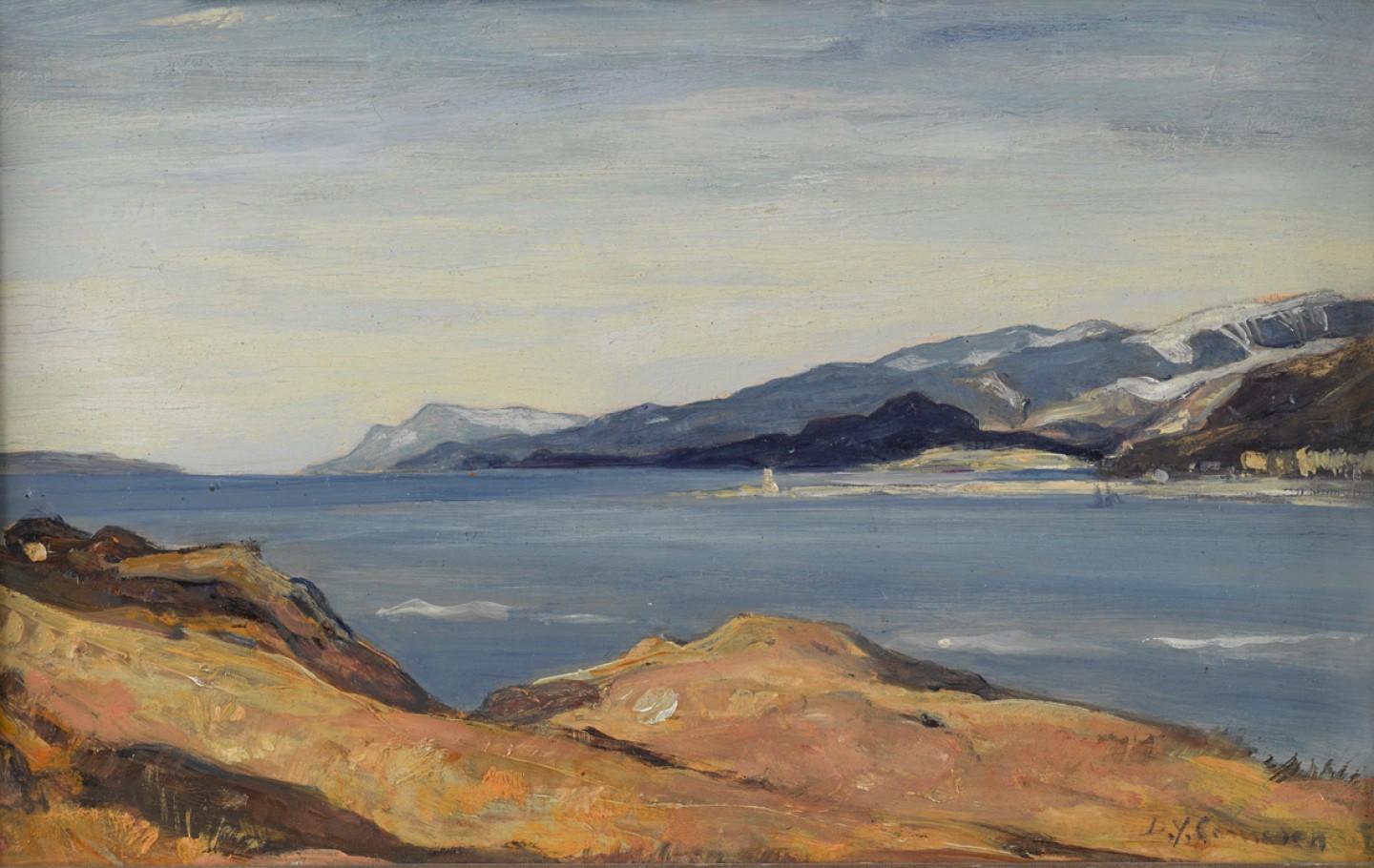
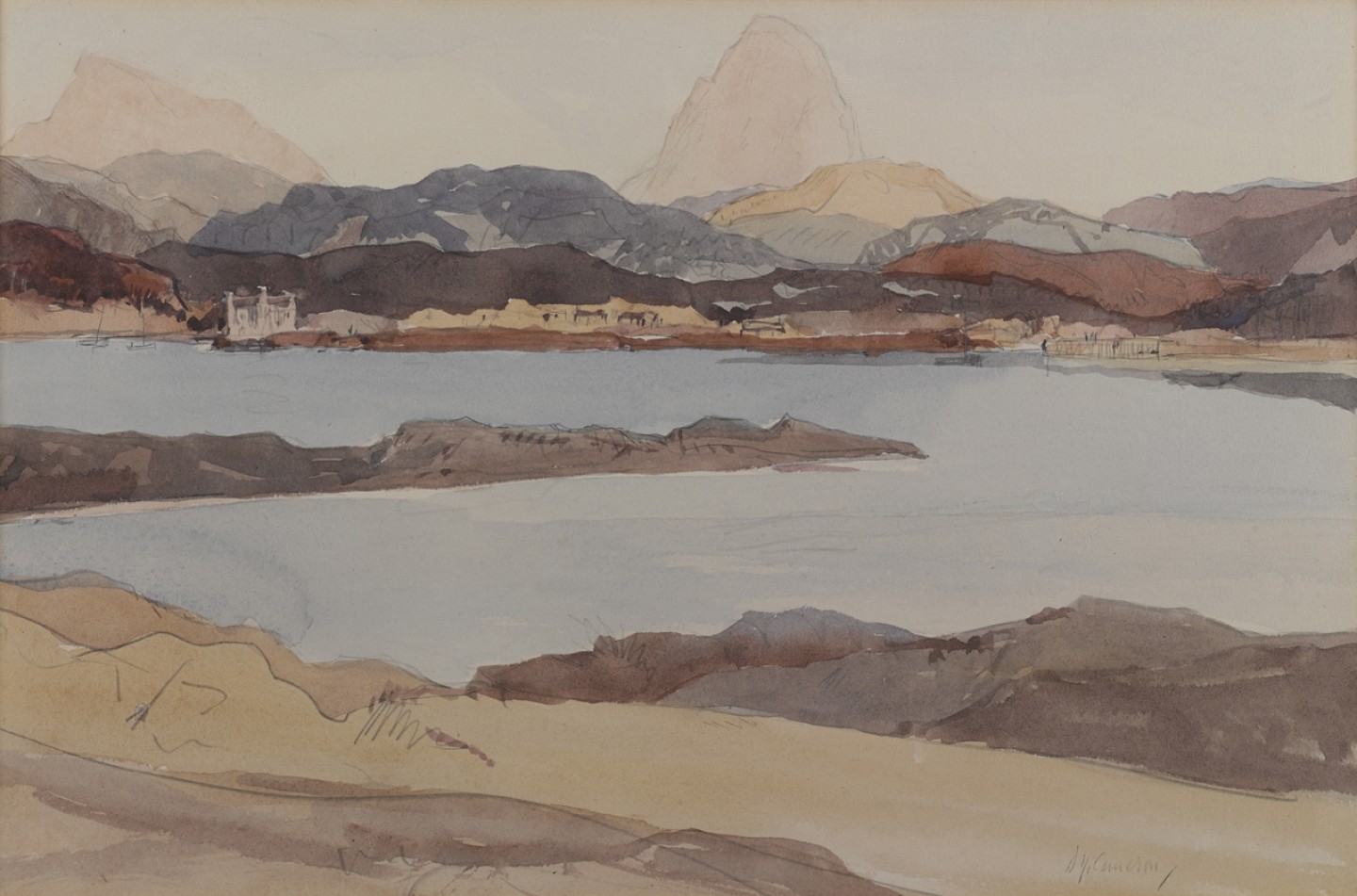
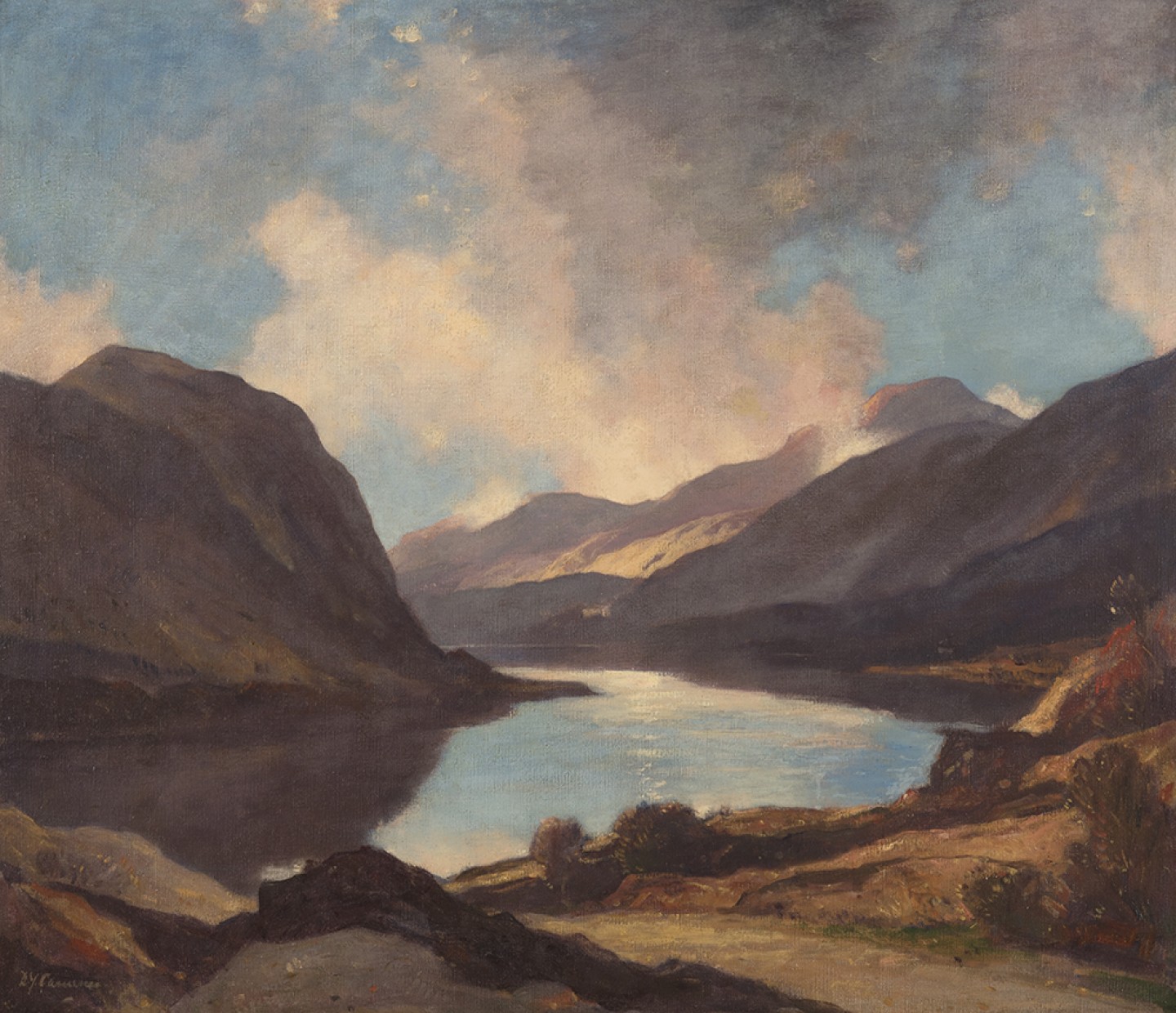
Cameron was a man of considerable importance and influence in British art circles in the 1920s and 1930s. His paintings attracted great critical acclaim and were acquired by many public art galleries in Britain and abroad. Sadly, the majority are today hidden in storerooms. Cameron's commitment to art extended well beyond the boundaries of the studio. During the second half of the First World War Cameron served as a war artist for the Canadian Government; he supervised the decoration of St. Stephen's Hall in the Houses of Parliament and of the rebuilt bank of England; he was associated with the British School in Rome for over twenty-five years; he was Trustee of the Tate Gallery and of the National Galleries of Scotland; and in 1933 he was appointed King's Painter and Limner in Scotland, an office previously held by Raeburn and Wilkie. Cameron was a son of the manse who’s deeply held religious faith was an important element throughout his life and imbued much of his work, particularly his landscapes. He devoted considerable time and energy to the Church of Scotland, advising many congregations on the redecoration of the churches.
Born in Glasgow, Cameron probably inherited his artistic ability from his mother, a talented amateur watercolourist, as did his sister, the watercolourist and etcher Katharine Cameron. While working in a Glasgow office he attended classes at Glasgow School of Art, and in 1884 he gave up office work -which he hated - in favour of painting, enrolling at Edinburgh School of Art, where fellow artists included W.M. Frazer and James Pryde.
However, it was as an etcher that Cameron first came to prominence. Like Rembrandt, who was a profound influence, Cameron was a master of light and shade, whether in a landscape, a street scene or one of his atmospheric church interiors. Over a period of some forty-five years he produced about 520 etchings and drypoints, becoming, with fellow Scots Muirhead Bone and James McBey, one of the foremost British etchers of the Etching Revival of 1880-1930.
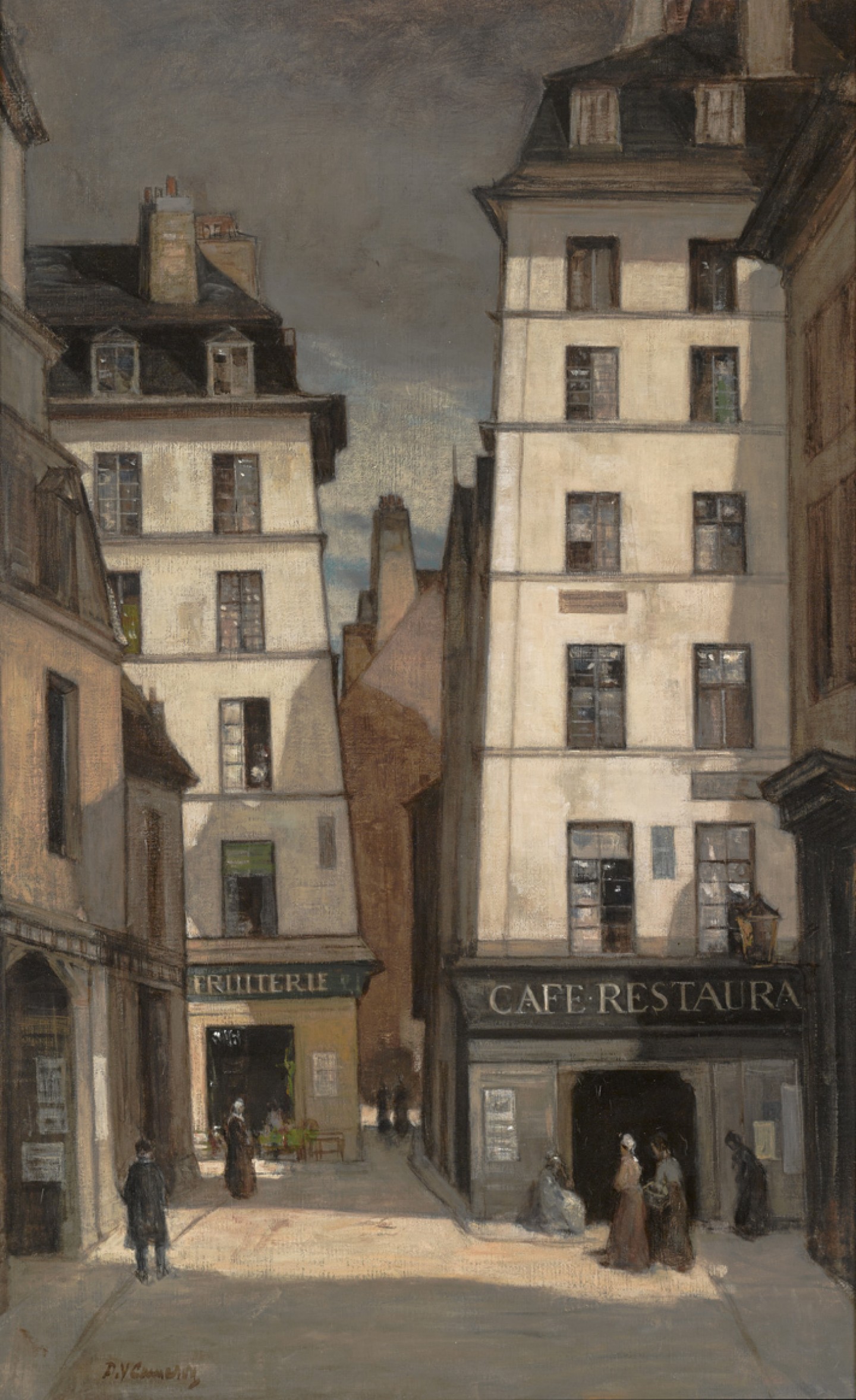
Today Cameron is remembered as a painter of the Scottish landscape. However, his oevre included figure subjects and portraits, townscapes and architectural subjects as well as landscapes. He travelled widely throughout a long working life. His oils and watercolours show a remarkable ability to convey the character and spirit of a place.