A Cairo Street
Arthur Melville


DESCRIPTION
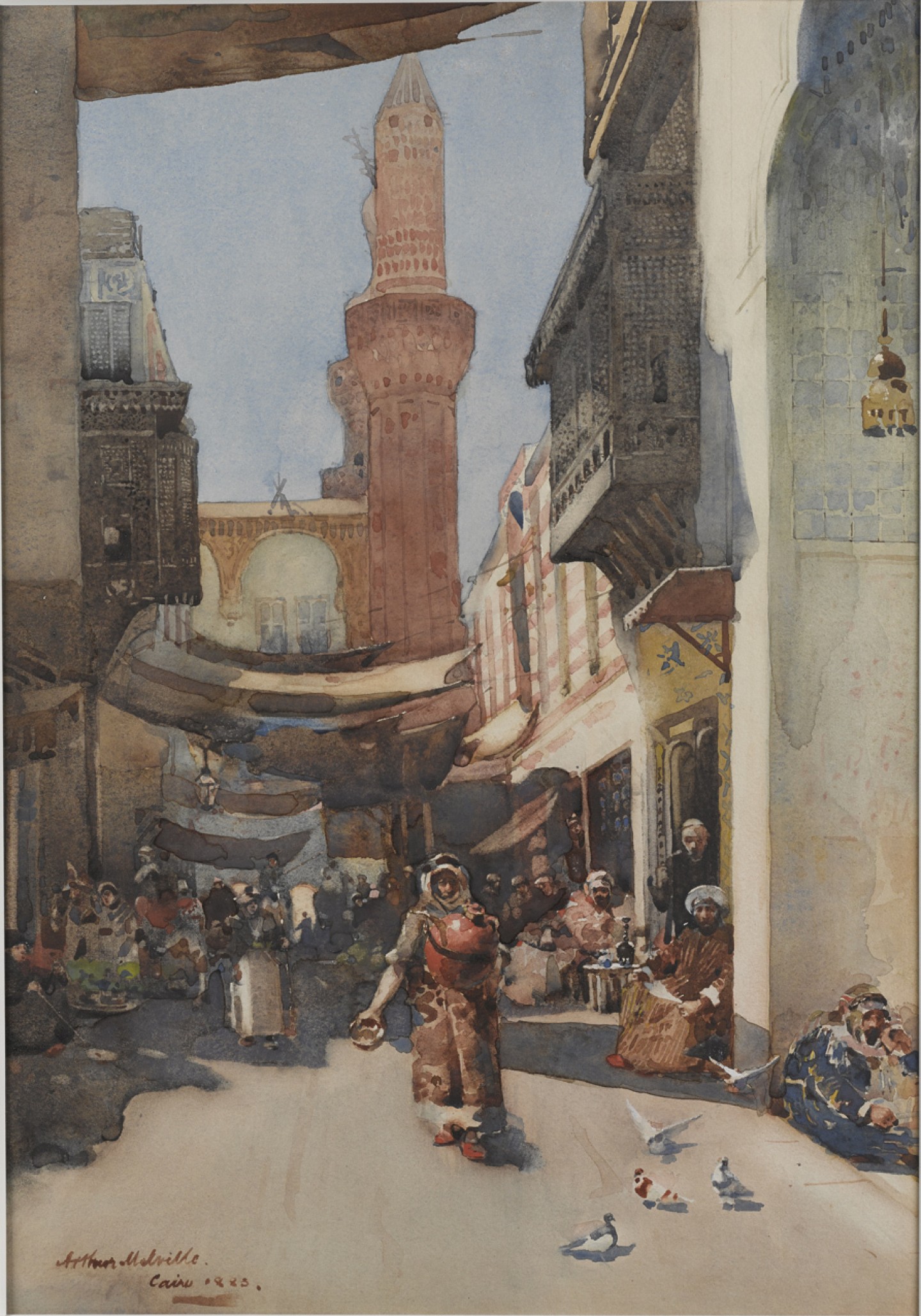
A Cairo Street by Arthur Melville (1855-1904) depicts a narrow street scene with a singular figure walking towards the viewer, while other figures are resting on the sides, in doorways, or blurred in the distance. Some of the figures even look directly towards the viewer. Melville captures the scene in soft, yet realistic detail with controlled washes of watercolour. His focus on balancing light and shadows is present with the way the fabric canopies separate the piece into the brightly, rich red and orange buildings and the darker, grey and brown tones of the shadowed street. While there are no explicit outlines on the figures throughout the piece, Melville's control of the watercolour is able to convey the sense of solidity and shape.
Melville was a well known watercolourist, often praised for an ability to create softened details in his work while still maintaining the subject. His strong interest in the balance of light within a work is present here in the precise way he captures the shadowed part of the street under the fabric canopies. Melville was also well travelled, having the privilege to explore much of Cairo and depict its street scenes, despite his aversion to working in the heat.
DETAILS
-
Artist
Arthur Melville
-
Date
1883
-
Medium
Watercolour on paper
-
Object number
634
-
Dimensions unframed
49 × 34.5 cm
-
Dimensions framed
86 × 64 × 2 cm
-
Marks
Signed, titled and dated bottom left
-
Subject
ARTIST PROFILE
Arthur Melville ARSA RWS RSW, 1855-1904
Born at Loanhead of Guthrie, Angus, Melville was brought up in East Lothian. At the age of fifteen he was apprenticed to the village grocer, but, determined to pursue his interest in drawing, he attended evening art classes in Edinburgh. In 1875, having exhibited and sold his first picture at the Royal Scottish Academy, he finally persuaded his parents to let him follow his chosen profession and was allowed to study in the studio of James Campbell Noble in Edinburgh. In 1878 Melville attended the Académie Julian in Paris and the following year went to paint at Grez-sur-Loing, south-east of Paris. it was at this time that he developed the "blottesque" watercolour technique which became his hallmark.
On returning to Edinburgh in 1880 Melville sold a number of his French watercolours, and made enough money to fund a journey to the Middle East. His experiences and work on that visit formed the basis of his future reputation as a painted of Oriental subjects, particularly in watercolour, in which he developed an individual style that was to exert a strong influence on other Scottish artists. Back in Scotland once again, he associated with many of his Glasgow contemporaries, notable Joseph Crawhall and James Guthrie. With Guthrie he was to make several painting trips over the following few years to Cocksburnpath, near Dunbar, Orkney and France. Although Melville himself was not regarded as one of the Glasgow Boys, he was seen by them to be a kindred spirit. In 1889 he left Edinburgh and settled in London, although he often returned to Scotland to paint. In London he became a popular and much-respected figure in the art world, a friend of Whistler and a member of the Committee of the International Society.
Melville is undoubtedly one of the greatest watercolourists of his period. One of the most vivid accounts of the development of his technique in the 1880s was written by his niece, Agnes Mackay, in her 1951 biography of him: "From now onwards he was to work in watercolour on prepared paper. This paper was impregnated with Chinese white, with which it was saturated again and again, and then finally rinsed, leaving a prepared surface. When actually at work he would at first make his drawing, indicating the essentials of his composition. Then he applied colour every wet with vigorous brushstrokes sponging out any superfluous detail, and again ran in the clear blue and reds in rich transparent tones ... he would put in his background on damp paper ... using umber to obtain his tone and when this was nearly dry he wold add the full bright patches of colour so characteristic of his painting."