
Scottish Art News
Latest news
Magazine
News & Press
Publications
The Forgotten Colourists
By James Knox, 13.06.2026
 - the music room, portrait of una dugdale c.1912.jpg)
The foundation of the colourist movement was forged in Paris in the years prior to World War I and at the heart of SJ Peploe and JD Fergusson’s circle in France were a group of female artists whose achievements have been largely overlooked. But the opening of the Scottish Colourists: Radical Perspectives exhibition at The Arc in Winchester this summer provides a fresh opportunity to celebrate their talent.
The trigger for this re-examination of their origin story is the loan from a private collection of one of the key works in the 1912 rhythmist exhibition in London. That show was the platform for Peploe and Fergusson and their female co-radicals, Anne Estelle Rice and Jessica Dismorr, to fight back against their deliberate exclusion from Roger Fry’s contemporaneous post-impressionist exhibition.
The loan in question is Ethel Wright’s cutting-edge swagger portrait of leading suffragette, Una Dugdale, who in 1912 had scandalised the patriarchy by refusing to ‘obey’ her husband in their marriage vows. Its inclusion at Winchester reunites for the first time since 1912 the work of Rice, Dismorr and Wright, three outstanding female artists. The trio were hailed at the time as fearless exemplars of contemporary painting, inspired by the likes of Matisse and Derain, who were known as the wild beasts (Les Fauves) for their savage approach to colour.
The following year, the fourth of the forgotten female colourists, Margaret Morris, joined Fergusson in Paris, although her contribution as a painter only came into focus – not unlike George Leslie Hunter’s trajectory – in the post- war years. Now, for the first time in the Scottish Colourists’ curatorial history, which stretches back over 100 years, the four forgotten colourists, all of whom – remarkably for the period – were women, can be saluted.
Ethel Wright
The Music Room, Portrait of Una Dugdale (c.1912) Private Collection
Trained at the Académie Julien in Paris, Ethel Wright’s career as a conventional portrait painter was radicalised by her growing commitment to the suffragette movement. Her 1908 portrait of its leader, Emily Pankhurst, now in London’s National Portrait Gallery, was followed four years later by her depiction of militant suffragette Una Dugdale, who had been arrested, gone on hunger strike and been force fed for the cause.
Furthermore, in 1912 she had caused public scandal when she refused to ‘promise to obey’ her husband in their marriage vows. Wright (c.1866–1939) expresses Dugdale’s audacity that same year with a bravura swagger portrait applied in a high-octane palette of complementary colours, red and green (a suffrage colour) set against the simplified geometry of the furnishings. By so doing, she achieves a sense of both control and abandon. The gilded screen in the background may allude to the furious male politicians debating in the House of Commons over women’s suffrage.
The following year, Dugdale published a polemical pamphlet Love and Honour Not Obey with a cover illustration by Wright of Dugdale wearing a bridal garland. In 1928, the year that universal suffrage was achieved, the Church of England introduced alternative wording – ‘to love and cherish’ – to the marriage vows. The painting’s inclusion in the rhythmist show, along with five other works including a landscape and still life, was most likely due to the acute eye of Wright’s acquaintance, the critic Michael Sadleir. He was co-editor of the niche art journal Rhythm, where Fergusson was art editor, and provided the creative platform for the exhibition.
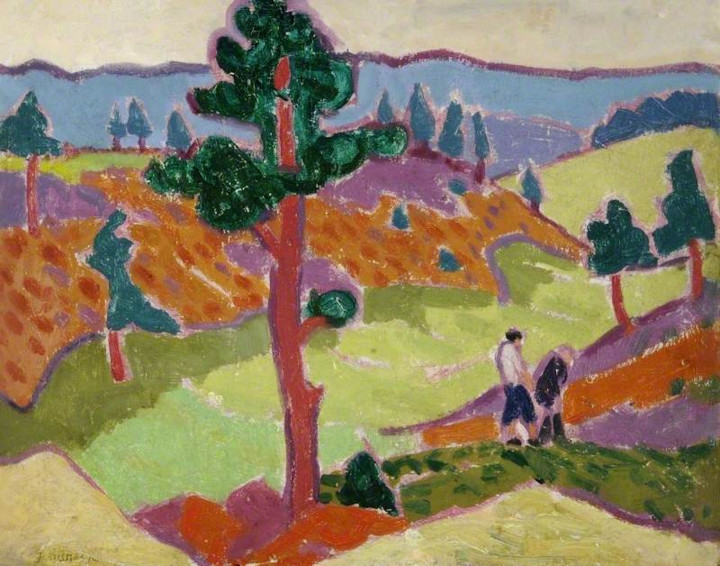 Jessica Dismorr. Landscape with Figures (1911–12). Sheffield Museums
Jessica Dismorr
Landscape with Figures (1911–12) Sheffield Museums
Jessica Dismorr (1885–1939) trained at the Slade School of Fine Art before moving to Paris where she attended the Académie de la Palette where JD Fergusson taught. He went on to commission graphics by her for Rhythm magazine. Her radical credentials are evident in this powerful fauve work which reveals the influence of Paul Gauguin. Dismorr was a member of the Rhythm Group before later becoming one of the leading painters in Wyndham Lewis’ vorticist movement which expressed the mechanisation of the rapidly changing modern world. Ever innovative, her later paintings were abstract. Dismorr ended her life in 1939 on the eve of World War II.
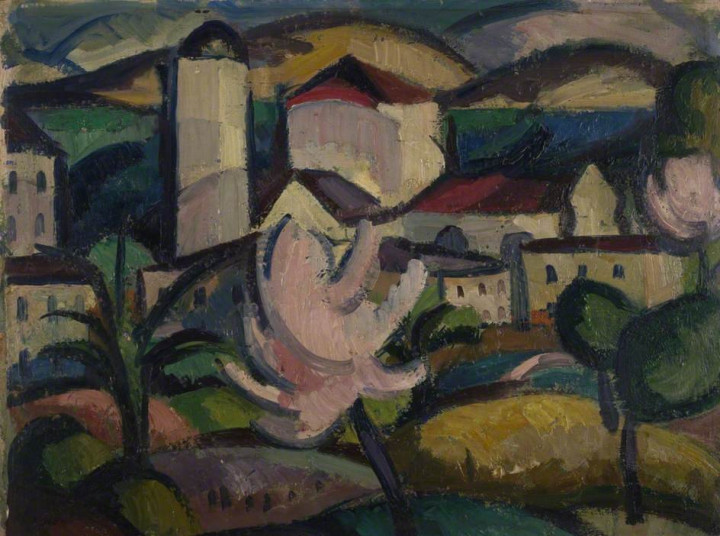 Anne Estelle Rice. Cote d’Azur (c.1915). Culture Perth & Kinross Museums & Galleries
Anne Estelle Rice
Cote d’Azur (c.1915) Culture Perth & Kinross Museums & Galleries
Born in Pennsylvania and trained at Pennsylvania Academy of Fine Arts, Anne Estelle Rice (1877–1959) started her career as a fashion illustrator, which brought her to Paris in 1905 with her journalist colleague, Elizabeth Dryden. Her meeting with Fergusson in 1907 at the resort of Le Touquet led to an intense romantic and artistic relationship, which fed into one another’s work. Their stylistic similarities are apparent in ‘Cote d’Azur’, which features painterly blocks of colour and defined outlines.
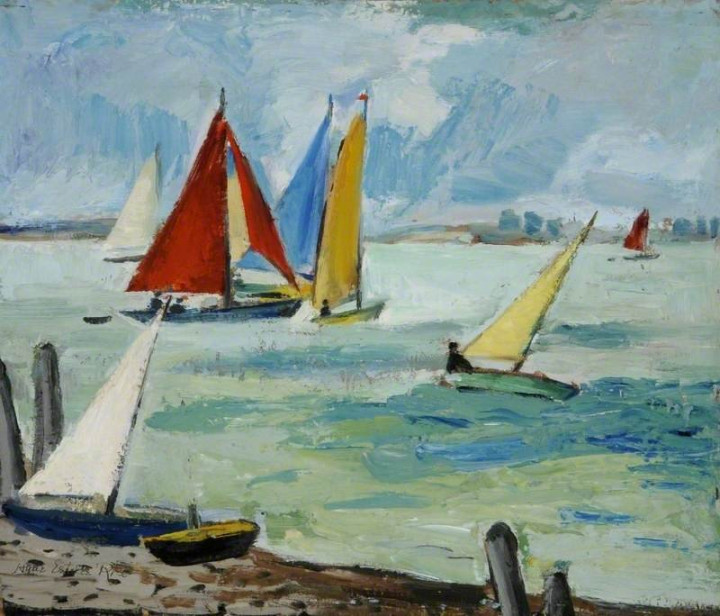 Anne Estelle Rice. Seascape with Sailing Boats (c.1912). University of Hull Art Collection
Anne Estelle Rice
Seascape with Sailing Boats (c.1912) University of Hull Art Collection
In the first issue of Rhythm magazine in 1911, Michael Sadleir, the influential critic and curator, hailed Rice as the ultimate fauve painter: ‘Whether it is sunlight or moonlight she is painting, figures or landscape, or boats on water, there is the same sense of surging design, the same bravery of colour, the same sincerity of vision.’ Rice had recently had a solo exhibition at the cutting- edge Baillie Gallery in London and was being recognised in Britain for her visionary work. Sadleir helped stage and curate the rhythm show.
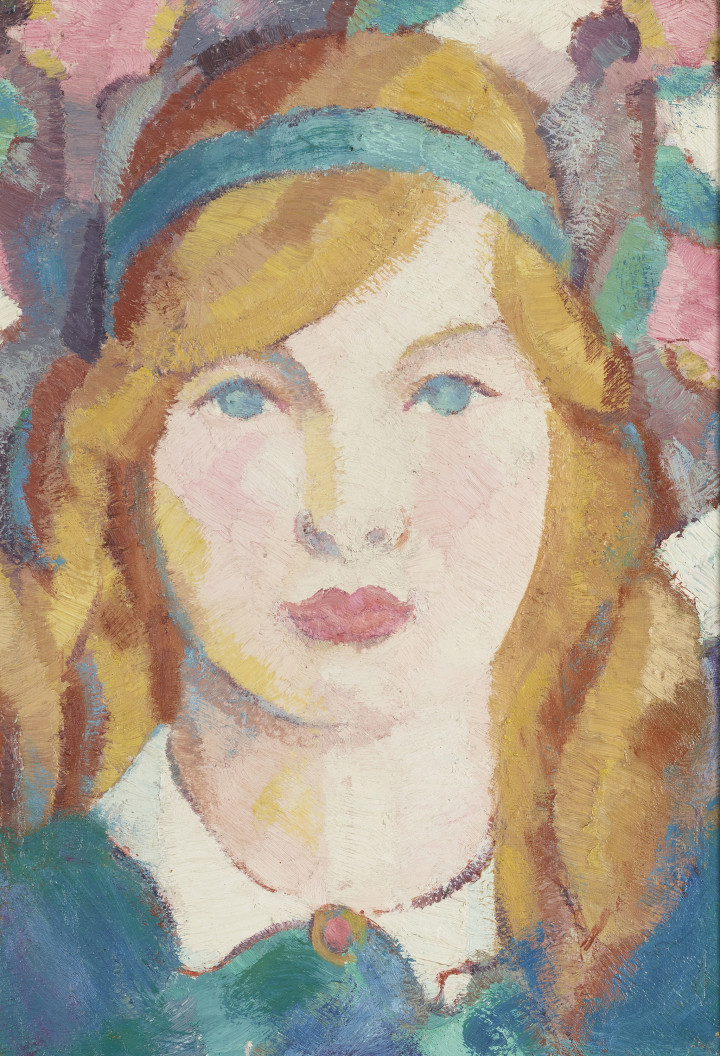 Margaret Morris. Portrait of Flossie Jolley (1924). The Fleming Collection
Margaret Morris
Portrait of Flossie Jolley (1924) The Fleming Collection
Born in London, Margaret Morris’ RSA parents (her father was an artist) encouraged her to paint and draw from an early age. This natural talent was subsumed by her career as a leading contemporary dancer, choreographer and teacher. Taking a troupe to Paris in 1913, Morris (1891–1980) met Fergusson. It was a coup de foudre and they became lifelong partners. They never married, nor had children, wishing instead to concentrate on their vocations. Her relationship with Fergusson was one of creative equals, he in turn designing sets and helping her run the dance company. Flossie Jolley was one of the original members of Morris’ first touring company. A critic described Jolley’s duet with another dancer as ‘gentle zephyrs blowing across the stage in veils of blue and grey’. Morris remained a creative force throughout her life and at the age of 81 trained the dancers of the experimental musical Hair when it opened in Glasgow in 1972.
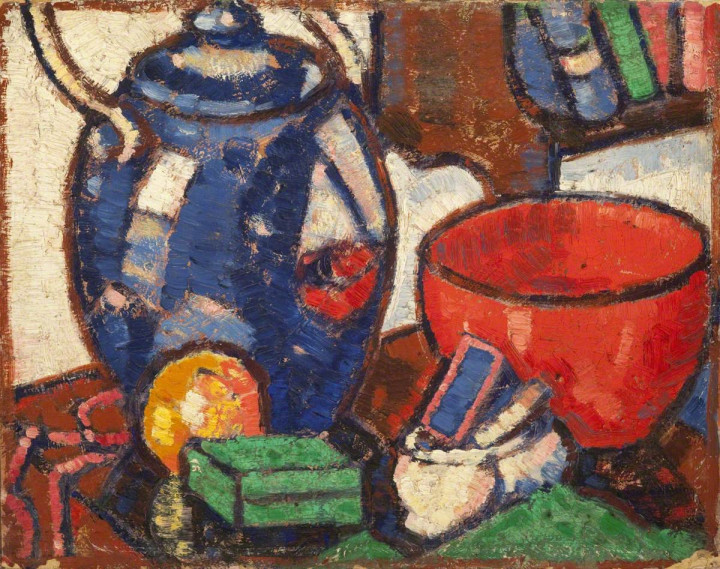 Margaret Morris. Red Bowl (c.1920). Culture Perth & Kinross Museums & Galleries
Margaret Morris
Red Bowl (c.1920) Culture Perth & Kinross Museums & Galleries
Morris’ career as a painter was encouraged by Fergusson and is reflected in her stylistic debt to him in this fauve-inspired still life.
Georges Banks
Portrait of Katherine Mansfield
Rhythm magazine (1912) The Fleming Collection
Although not one of our four forgotten colourists, graphic artist and caricaturist Georges Banks (1885–1953) was a key member of Fergusson’s creative circle at Rhythm magazine. Her caricature of the aspirant writer, Katherine Mansfield, deputy editor of Rhythm, was exhibited in the rhythmist exhibition along with other work. The daughter of an Edinburgh lawyer, Banks adopted a male pseudonym in homage to the 19th- century female novelist, George Sand, and was known to adopt male clothing. Fergusson wrote on her death: ‘She was part of a kind of life which may never again be as wonderful, and it took people like Georges Banks to make it wonderful.’ Even more so than her female peers, Banks has been totally forgotten.
Scottish Colourists: Radical Perspectives is exhibited at The Arc, Winchester until 16th September


