
Scottish Art News
Latest news
Magazine
News & Press
Publications
Paul Mellon Centre for Studies in British Art publishes monumental David Wilkie catalogue raisonné
By Nick Tromans, 02.11.2026
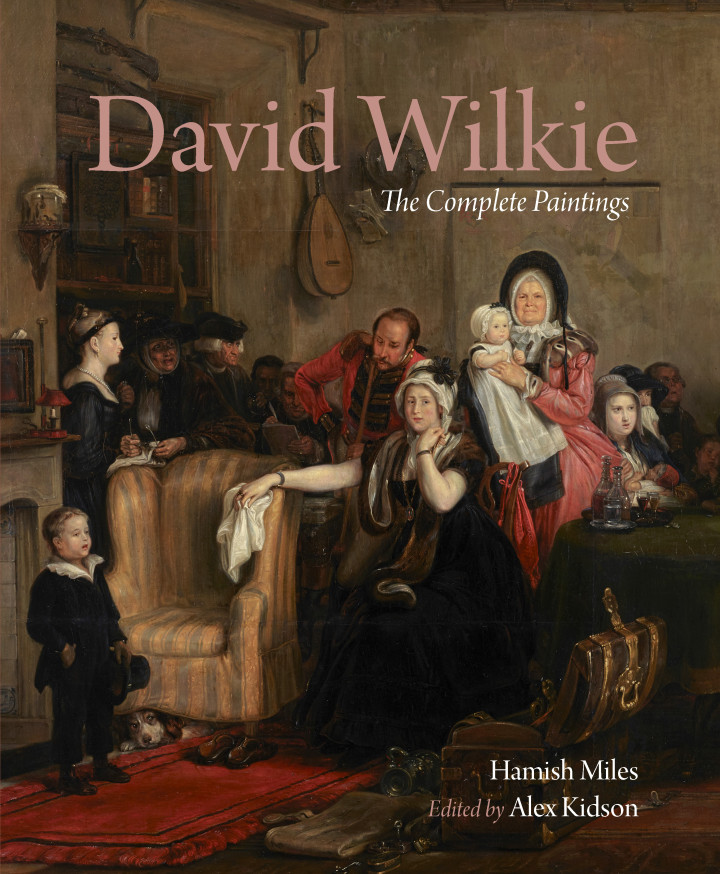
This month sees the publication of a true landmark in Scottish art history – the complete catalogue of the paintings of David Wilkie (1785 –1841). Born in Fife in 1785, it is no exaggeration to say that Wilkie became the most popular British artist of the early nineteenth century, eclipsing even Constable, Raeburn and Turner in the reach of his international reputation.
Wilkie painted people interacting, negotiating, arguing with one another – in pubs, parlours and palaces, in contexts fashioned from historical and fictional literature as well as from the material culture that survived around him. His social microcosms captivated the imaginations both of sophisticated collectors who swooned over his unmatched mastery of the art of oil painting, and of generations of unnamed admirers who knew only the best-selling engravings after Wilkie’s pictures. Such was the influence of his little pictorial worlds that Wilkie came to appear the godfather to great swathes of Victorian painting in Scotland and beyond, and came to suffer by association with that ubiquitous visual culture of anecdote and parochialism. With the appearance of this monumental study, we will now be able fully to appreciate, in all their intricate histories, every one of Wilkie’s own works.
The story of the Wilkie catalogue raisonné has attained legendary status within art-historical circles. It was begun by the late Professor Hamish Miles as long ago as the 1960s but left incomplete at his death in 2017. The Paul Mellon Centre for Studies in British Art, the London-based outpost of Yale University, had backed the project from the start, and have shown admirable loyalty to it by commissioning Alex Kidson to complete the work and shape it into what we now see.
Miles was an academic art historian whose primary interests were originally in European painting of the 16th and 17th centuries. He held posts at the universities of Glasgow, Leicester and Birmingham, and while serving as Professor of Fine Art at the latter, also held the position of Director of the Barber Institute, to whose collections he was able to make many important additions. As a Professor in the new discipline of the History of Art (new at any rate to British universities), Miles felt a duty to show the way by doing some seriously heavy archival lifting, to authoritatively survey something weighty and concrete in the way that academics in Literature departments might be expected to spend a career defining the corpus of a famous author, or a musicologist might painstakingly reconstruct that of an historical composer. Wilkie’s reputation certainly needed reconstructing by the 1960s, for of course nineteenth-century genre and historical painting had scarcely been considered to be art at all during the preceding decades. For Miles, the fascination of Wilkie lay in his art having been social in its making as well as in its content. The artist had been the polar opposite of the isolated expressionist, inviting input from those around him and openly discussing all aspects of his art with a great range of interesting correspondents.
The challenge of the catalogue of Wilkie’s pictures, as Miles elaborated it over several decades, was in somehow compressing this rich verbal life into an object-by-object format incorporating such conventional details as provenance and exhibition history. The work evolved into something like a vast group portrait of early nineteenth-century British cultural life, seen, in eye-poppingly high resolution, through the fine grain of Wilkie’s images and words. Eventually, the texts for some of Wilkie’s best-known pictures were running into tens of thousands of words, becoming more like essays or even monographs in their own right than conventional catalogue entries. The flow of knowledge had burst its banks.
Alex Kidson came to the project in 2018 ideally qualified to form the bridge between Miles’ astonishing scholarship and the realities of making a book. For many years curator of British art at the Walker Art Gallery in Liverpool, Kidson had already completed a three-volume catalogue of the paintings of George Romney which appeared in 2015 (also with the Paul Mellon Centre).
“I’m actually not a Wilkie expert myself”, Kidson admits. “I once corresponded with Hamish about a Wilkie portrait I was cataloguing in Liverpool, and I think my question intrigued him – his response was sort of alert and interested – and kind. But I had no wish to make his catalogue in any way my intellectual property.” Nevertheless, his role has not been just that of senior pruner. Getting on for half of Miles’ encyclopedic manuscript did get cut away, but Kidson – with help from his research collaborator Kyle Leyden, now of the Courtauld Institute – has brought plenty, too. There were precious few paintings missed by Miles, to add fresh to the catalogue (although an entirely unknown version of ‘The Reading of a Will’, now on the cover of one of the two volumes, was one of these). But there were text and exhibition references to chase down, commensurate in number to the scope of the text, which is say thousands of them.
“This process”, Kidson says, took longer than the edit itself, and that’s with Kyle to help me.” Also, he wanted the catalogue to say more about Wilkie’s drawings. Miles had been clear from the outset that to give the last word on Wilkie’s paintings was more than enough for one lifetime’s work, so here was a fundamental aspect of the catalogue to which Kidson could make an original contribution. As he recalls, “The first time that I felt like I was contributing to Wilkie scholarship was when I corrected an inscription on a drawing of a cottage interior in the Rijksmuseum. There was a date, and before it a word that Hamish had tentatively read as ‘Monday’. But I could see it was actually ‘Inverary’”. The user of this catalogue, whose publication is so very welcome after such a long wait, can certainly read assured that the scholarly effort that has been invested in it, by Miles and then by Kidson, is entirely worthy of the one of the greatest of Scottish artists.
The Fine Art Society, Edinburgh is hosting a panel discussion David Wilkie: Creating a Catalogue Raisonné on Thursday 19th November 2:30-4pm. Panellists include Nick Tromans and Alex Kidson, more information here.


