
Scottish Art News
Latest news
Magazine
News & Press
Publications
Old Master Paintings on Tour: from Buckingham Palace, London to Holyroodhouse, Edinburgh
By Shalmali Shetty, 26.01.2026
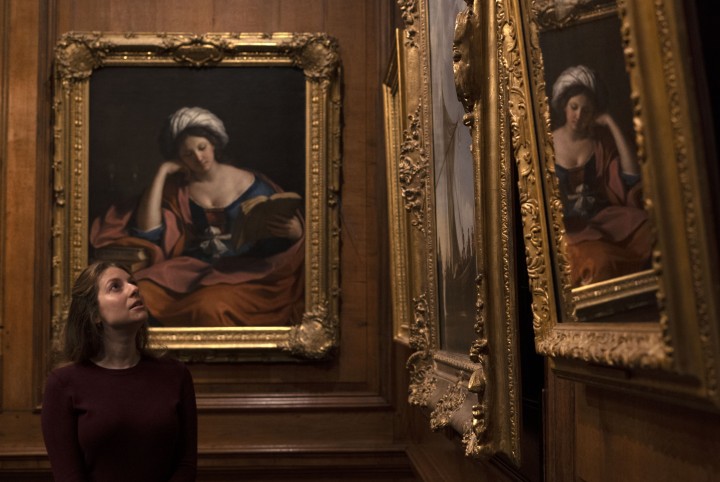
Italian, Dutch & Flemish Paintings: Highlights from Buckingham Palace brings together eight paintings from the 16th and 17th centuries, currently on view at the Palace of Holyroodhouse in Edinburgh alongside its permanent collection. Drawn from the Royal Collection Trust and usually on view in the Picture Gallery at Buckingham Palace, the paintings have travelled to Scotland for a temporary period while the gallery undergoes a rehang, marking their first appearance here in over a decade. The display is primarily focused on providing Scottish audiences access to a valuable selection of works from the European canon, rather than offering new thematic or curatorial interpretations. Presented in a linear arrangement within a small, wood-paneled room set apart from the palace’s main guided route, the display spans the Renaissance, Baroque, and Golden Age across Italy, the Netherlands, and Flanders.
.jpg) Titian, Portrait of Jacopo Sannazaro (c. 1514). © Royal Collection Enterprises Limited 2025 | Royal Collection Trust.
Titian, Portrait of Jacopo Sannazaro (c. 1514). © Royal Collection Enterprises Limited 2025 | Royal Collection Trust.
Relying on the authority of familiar names of European masters, they include portraits of aristocrats and biblical figures alongside scenes depicting quotidian working life. Titian’s ‘Portrait of Jacopo Sannazaro’, (Italy, 1514) presenting the celebrated court poet and scholar; Parmigianino’s ‘Portrait of a Young Nobleman’, (Italy, 1531) marked by a restrained, introspective presence; and Frans Hals’s ‘Portrait of a Man’, (Netherlands, 1630) featuring an unidentified aristocratic sitter captured with brisk, expressive brushwork, draws attention to the clean, stylistic approaches of Renaissance portraiture in presenting authoritative figures through formal, composed poses. Rendered in largely restrained palettes, these portraits illustrate the technical skill and characterisation for which these artists are renowned, while also reflecting the patronage systems that sustained artistic production at the time.
 (1).jpg) Pieter de Hooch, A Courtyard in Delft at Evening: A Woman Spinning (1657). © Royal Collection Enterprises Limited 2025 | Royal Collection Trust.
Pieter de Hooch, A Courtyard in Delft at Evening: A Woman Spinning (1657). © Royal Collection Enterprises Limited 2025 | Royal Collection Trust.
In contrast, the landscape and interior scenes shift the attention away from figures of status towards domestic life, labour, and commerce, offering some of the most visually engaging works. By portraying the working class as subjects rather than agents, these paintings reveal the social hierarchies of the period. This is particularly evident in Pieter de Hooch’s ‘A Courtyard in Delft at Evening: A Woman Spinning’, (Netherlands, 1657), which presents a quiet courtyard with meticulous attention to brickwork, architecture, and light - a precision possibly influenced by his father, a master bricklayer. Similarly, David Teniers the Younger’s ‘Interior of a Farmhouse with Figures (The Stolen Kiss)’ (Belgium, 1660), depicts a father as he catches a labourer misbehaving with his daughter, creating a lively theatrical scene of humour, with a subtle, cautionary edge. Aelbert Cuyp in ‘The Passage Boat’, (Netherlands, 1650), further captures the bustling ferry traffic and maritime trade of the Dutch Republic, conveying the noise and energy of the expanding industrial period.
. © royal collection enterprises limited 2025 royal collection trust..jpg) Cristofano Allori, Judith with the Head of Holofernes (1613). © Royal Collection Enterprises Limited 2025 Royal Collection Trust.
Cristofano Allori, Judith with the Head of Holofernes (1613). © Royal Collection Enterprises Limited 2025 Royal Collection Trust.
Alongside this, mythological and biblical themes also surface blurring the boundaries between portraiture and narrative painting. Cristofano Allori’s ‘Judith with the Head of Holofernes’, (Italy, 1613) illustrates the story in a carefully arranged, dramatic tableau, marking an early example of a biblical subject that would become one of his most famous and frequently reproduced works. Likewise, Guercino’s ‘The Libyan Sibyl’, (Italy, 1651) portrays the introspective, prophetic figure Phemonoe absorbed in a book, rendered in contrasting warm and cool tones that sets it apart from the other portraits.
. © royal collection enterprises limited 2025 royal collection trust..jpg) Guercino, The Libyan Sibyl (1651). © Royal Collection Enterprises Limited 2025 | Royal Collection Trust.
Guercino, The Libyan Sibyl (1651). © Royal Collection Enterprises Limited 2025 | Royal Collection Trust.
In addition to the Holyroodhouse collection, the adjacent King’s Gallery is presenting Drawing the Italian Renaissance, bringing together drawings, studies, and preparatory materials by over fifty well-known and lesser-known artists. From Michelangelo’s chalk and metal point studies to Leonardo da Vinci’s mirror writing and anatomical studies, alongside technical insights into pigment, papermaking, plastering, and fresco techniques, the exhibition reveals the Renaissance atelier as a site of labour and industry, tracing networks of teachers and students, the circulation of materials, and the patronage that shaped art during this period.
The special display Italian, Dutch & Flemish Paintings: Highlights from Buckingham Palace is included in a visit to the Palace of Holyroodhouse until the end of March 2026.


