
Scottish Art News
Latest news
Magazine
News & Press
Publications
Marjorie Kemp, the Scottish Stained Glass artist Argentina never forgot
By Sebastian Pasquet, 06.09.2026
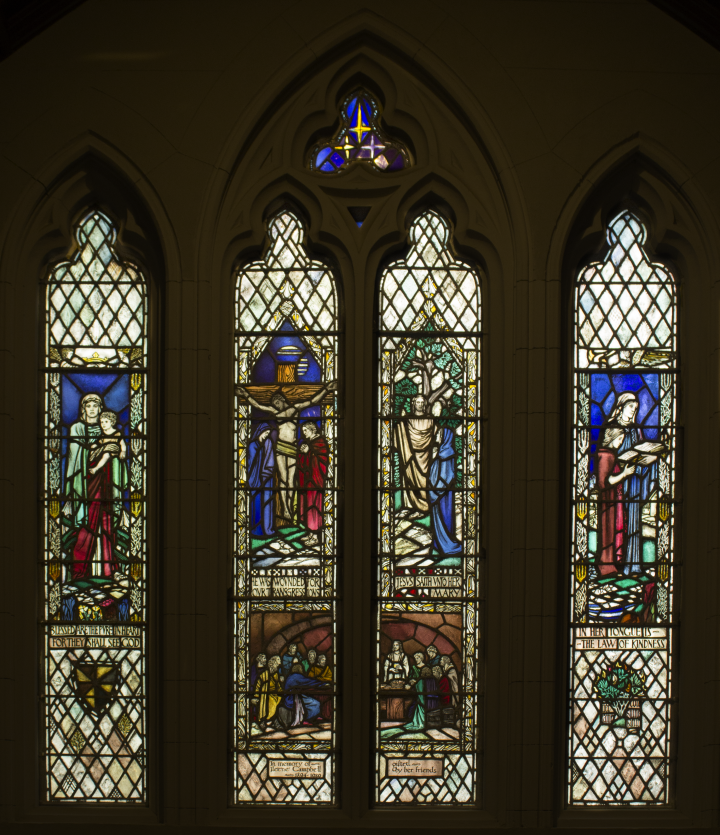
What if women artists' names were the ones recorded in our archives, and celebrated through history while men's names were lost and forgotten? Well, that is, on a tiny scale, what happened in Argentina regarding Scottish stained glass artists. Probably more by absolute chance than by an intentional community decision. But in any case, it's a welcome exception.
In a recent article for Scottish Art News, by focusing on David Gauld’s work, I tried to paint a picture of the international relationships that made possible the presence of dozens of Scottish artworks that can still be found in Argentina today. However, among all those works only one artist’s name has ever been recorded in the documents of the Scottish-Argentinian community of the time. And by doing so, only one name has been passed down from generation to generation in booklets and documents for almost a hundred years now. That is: Marjorie Kemp.
Marjorie Kemp was born in Blairgowrie in 1886. She studied at the Glasgow School of Art and later established a stained-glass workshop in Edinburgh with Margaret Chilton. Although the two collaborated, they appear to have managed most of their commissions independently.
In 1931, Kemp was commissioned to create the chancel window for a church in Buenos Aires. And the completed work was installed in 1932. The original quote from the June 1932 issue of the Scotch Church Magazine of Buenos Aires states: “The Window was designed and made by Miss Marjorie Kemp of Edinburgh who is one of the very best stained glass artists in Great Britain and who recently exhibited at the Exhibition of Ecclesiastical Art held in Dunblane Cathedral – the first Exhibition of its kind ever to be held in a Presbyterian Church. Miss Kemp is to be congratulated on the artistry of the work in this Window which beautifies our House of Prayer.”
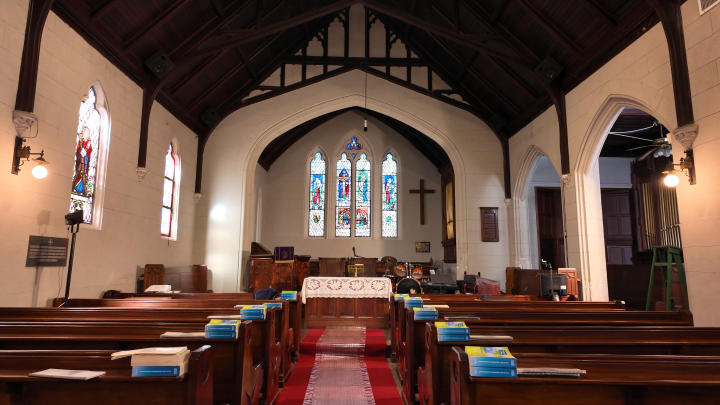 Interior of Dr Smith Memorial Church, Belgrano, Buenos Aires. Image Courtesy of Sebastian Pasquet.
As a researcher, reading such praise for an artist who has just been commissioned is neither uncommon nor actual evidence that such artistry has been achieved. So I must admit that my first approach to the work was focused on its historical and decorative value.
Unlike the works of Gauld, Kemp's work isn’t monumental, nor does it have the explosion of colour or other technically breathtaking elements. Rather, it is placed in a small Presbyterian church, known as Dr Smith Memorial, in the neighbourhood of Belgrano. A building strongly reminiscent of Scottish rural churches, designed in 1908 by the Scottish architect Walter Dawson Campbell.
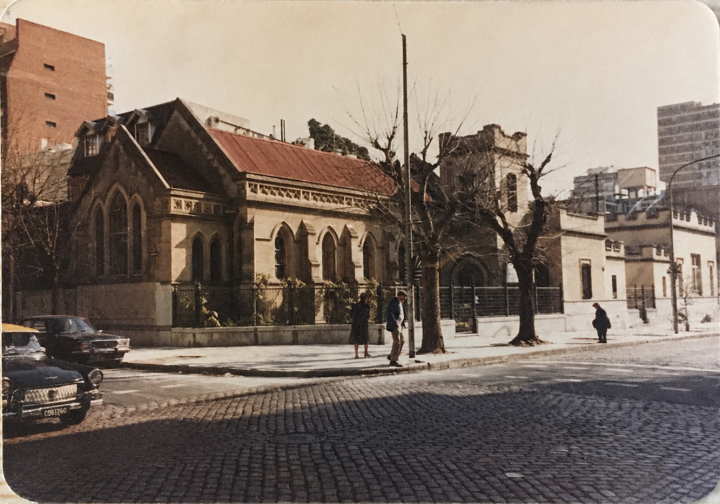 Exterior of Dr Smith Memorial Church, Belgrano, Buenos Aires. Image Courtesy of Sebastian Pasquet.
The piece appears quite simple at first with its abundant use of white glass, the pale faces and the apparent rigidity of the human figures. Also, the general composition seems to lack complexity, being symmetric and geometric. Nothing announces itself. But the longer one looks, the less plain the work becomes.
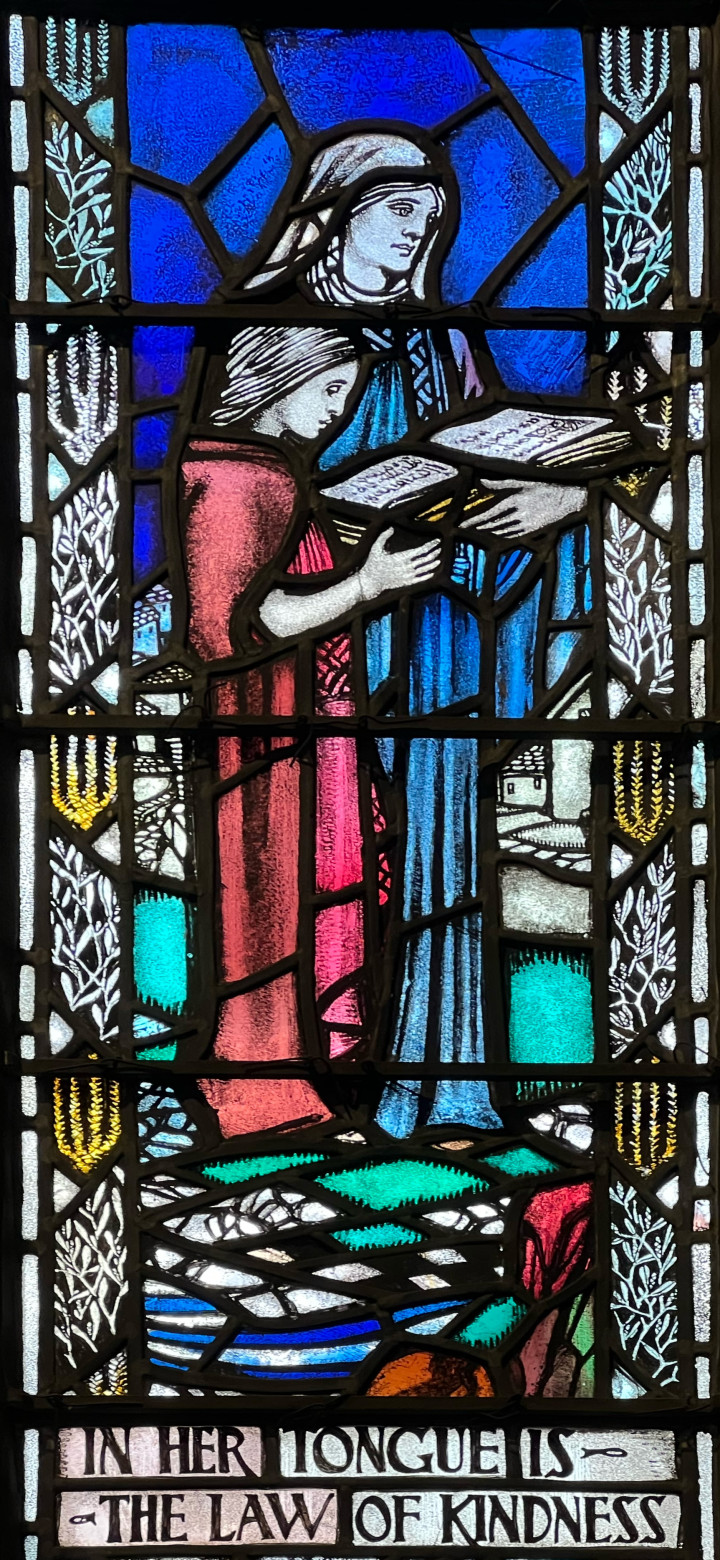 Marjorie Kemp. Detail of Stained Glass work at Dr Smith Memorial Church, Buenos Aires. Image Courtesy of Sebastian Pasquet.
The simplicity begins to reveal itself as one of its strengths. Nothing in the work lacks expression. The figures carry tension and attentiveness. The thick lead lines also begin to take an expressive sense. And the colours that appeared plain from a distance include unique streaky glasses in precise locations when watched closely. Even the way Kemp frames the different scenes rewards attention. The biblical episodes are distinguished from the illustrations connected to the person commemorated by the window through different framing devices.
And finally, there is one corner in particular that summarises Kemp’s artistry. In the lower right-hand corner appear the symbol and motto of the Church of Scotland: the Burning Bush and the words “Nec Tamen Consumebatur” (“Yet it was not consumed”). These elements are almost omnipresent in Church of Scotland visual culture. Most representations tend to resemble one another. Yet Kemp manages to create something personal, while not in a loud or demonstrative way. Her version appears deconstructed. Fire and leaves seem separate and yet one. Rarely does this image seem both aflame and fully alive, green and flourishing at the same time.
 from stained glass in dr smith memorial church, buenos aires. image courtesy of sebastian pasquet.jpg) Marjorie Kemp. Burning Bush (detail) from Stained Glass in Dr Smith Memorial Church, Buenos Aires. Image Courtesy of Sebastian Pasquet.
Marjorie Kemp. Burning Bush (detail) from Stained Glass in Dr Smith Memorial Church, Buenos Aires. Image Courtesy of Sebastian Pasquet.
I do not know exactly what the writer of the original quote valued in the work, nor what drives the interest of other researchers today. But after spending time on the work, I know it is moving. And against the general perception of stained glass, which is often relegated to the category of decoration, Marjorie Kemp's work in Argentina, like that of Gauld and many other artists, suggests something more. It reminds us that stained glass gave Scottish artists with a personal vision and style the opportunity to receive meaningful commissions from small communities around the world. Works that almost a century later remain visible and appreciated. Not hidden away in a storage room nor hung on the sacred walls of museums but alive within other real social, communal and ritual spaces.


