
Scottish Art News
Latest news
Magazine
News & Press
Publications
Lubaina Himid on Belonging in Places Elsewhere
By Shalmali Shetty, 06.08.2026
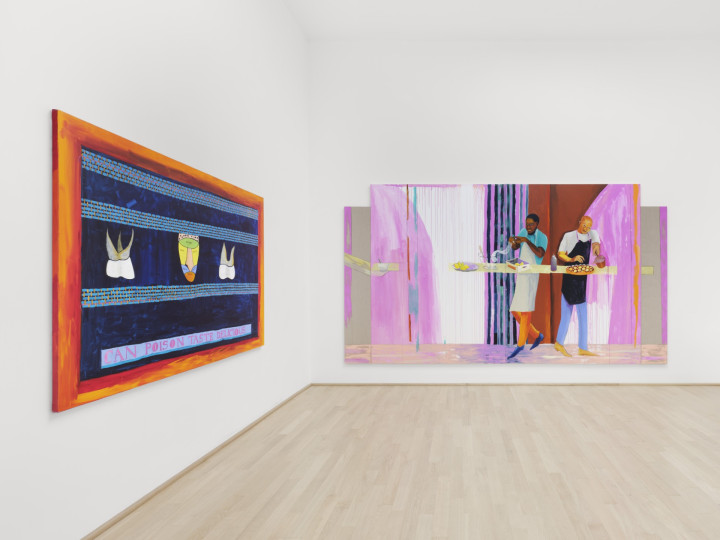
In 1997, Lubaina Himid created ‘Venetian Maps’, a series of nine canvases that unspooled the overlooked African presence and submerged histories resting beneath Venice’s canals and lagoons. Nearly three decades later in 2026, Britain eagerly anticipated her presentation at the British Pavilion for the 61st Venice Biennale with Predicting History: Testing Translation.
Unlike what many may have expected of the free-standing cut-outs and installations that have come to define much of Himid’s practice, this display comprising monumental multi-panelled paintings achieves an immersive space just through the two-dimensionality of the painted surfaces. Himid’s vibrant figures appear to be stepping from the pages of a children’s storybook. Never at rest, the quotidian labour of the Black working-class individuals is animated by colours, patterns, and motifs drawn from the kanga textiles of her East African heritage in Zanzibar, bringing a native visual language into the neoclassical architecture of the Pavilion.
Each room is organised around a distinct profession: Architects, Tailors, Chefs, Boatbuilders, and Gardeners; occupations that build and sustain homes, and by extension nations, often without the workers ever fully belonging to either. This raises a disconcerting question: how does one feel at home in a place that refuses to welcome them; or when a sense of belonging is never fully returned?
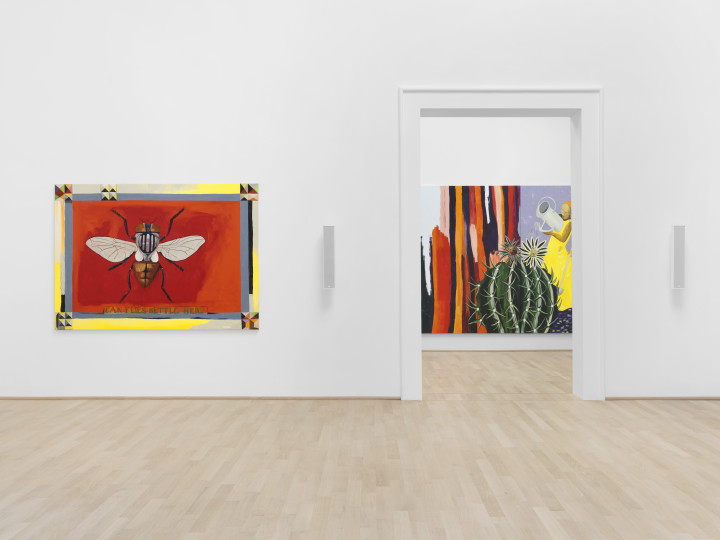 Lubaina Himid. Architects. Commissioned by The British Council. Image by Eva Herzog.
A small, unsettling painting of a fly paired with the text “Can flies settle here” is the only thing that seems truly at rest, further directing our gaze across the room to the main painting, Architects. Formed of multiple panels that resemble architectural beams, the work is structured like a storyboard, its narrative sequence unfolding from left to right: first laying out architectural blueprints, followed by a single, enlarged cylindrical enclosure. Next, a patterned vertical band drops down like a theatrical curtain (a nod to Himid’s background in stage design) evoking borders, thresholds, and the imperfect act of “translation.” This staging speaks directly to the exhibition’s title and the condition of remaining suspended between the possibilities of different worlds, leading the eye to two figures in conversation as one cradles a house and the other holds a car: a poignant contrast between staying put and being on the move.
In the room of the Chefs, a smaller painting of a diagram of a tongue with taste buds flanked by two teeth is paired with the text “Can poison taste delicious.” This leads into the larger composition where two figures prepare food, not native to their own culture: how do you find a sense of belonging when the very ingredients and culinary traditions are not your own? Similarly, in Gardeners, “Is water always useful” leads to a composition of botanical diagrams, followed by two figures watering a flowering cactus that has grown improbably large in a non-native environment.
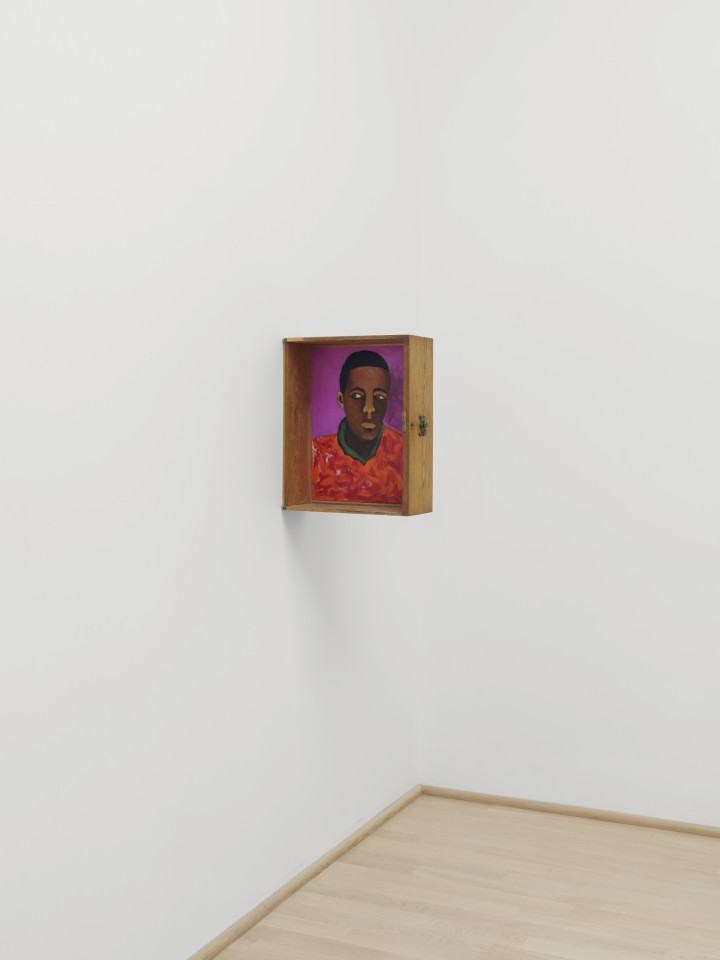 Lubaina Himid. Painting in the Room Boatbuilders, A Small Wooden Drawer Protrudes from the Wall, Containing the Portrait of a Solitary Man. Commissioned by The British Council. Image by Eva Herzog.
Water recalls the maritime histories that run through Himid’s wider practice: the routes of trade, migration, and the displacement wrought by the transatlantic slave trade. Both Venice and Britain stand as potent reminders of empires built through sea-borne conquest, as well as the ongoing movement of people forced from their homelands into perilous sea routes. This weight takes form in the Boatbuilders room, where a small wooden drawer protrudes from the wall, containing the portrait of a solitary man. Separated from the surrounding figures, he appears withdrawn and hidden at the margins. Nearby, 21 painted oars are installed on the wall, resembling an ethnographic museum display.
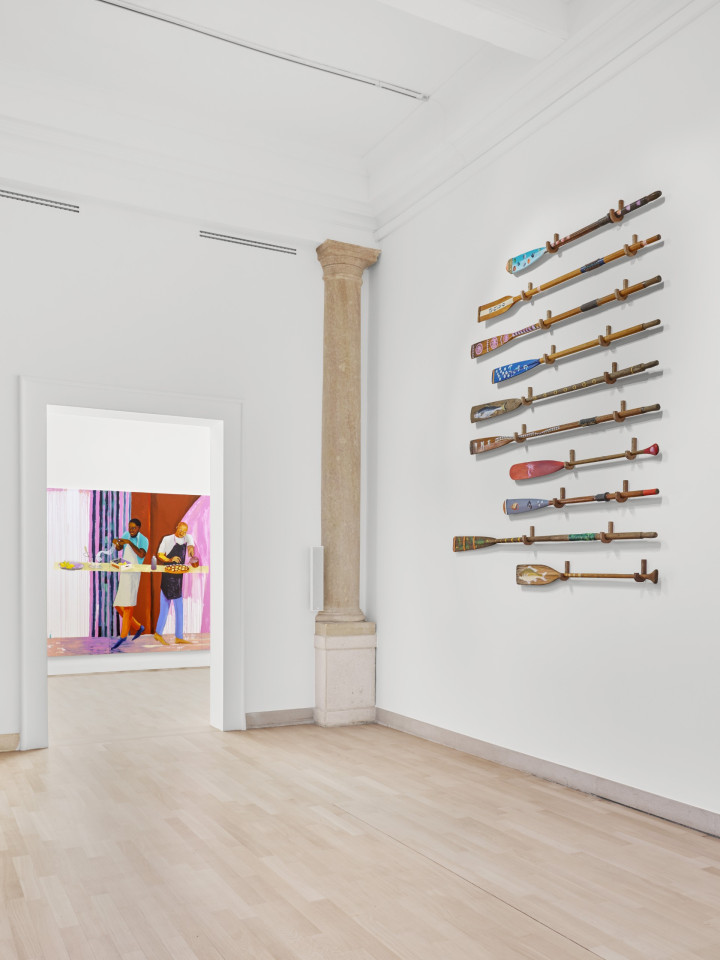 Lubaina Himid. Oars. Commissioned by The British Council. Image by Eva Herzog.
An accompanying soundtrack, created with collaborator Magda Stawarska, envelops the space with pastoral birdsong, insect chatter, voices and tunes reminiscent of an idyllic English summer day, playing directly into the title of the biennale, In Minor Keys. By operating in these "minor keys" and alluding to displacement, home and belonging become a continuous testing of translation, never completely detached from one’s own environment.
Lubaina Himid’s exhibition, Predicting History: Testing Translation, is exhibited at the British Pavilion until 22nd November. The works then tour to The Herbert Art Gallery & Museum, Coventry (12 February – 23 May 2027), The MAC, Belfast (11 June – 22 August 2027), and Glynn Vivian Art Gallery, Swansea (24 September 2027 – 9 January 2028).


