
Scottish Art News
Latest news
Magazine
News & Press
Publications
Let There Be Light: Camera-less and Eco-Photography in Scotland
By Greg Thomas, 26.08.2026
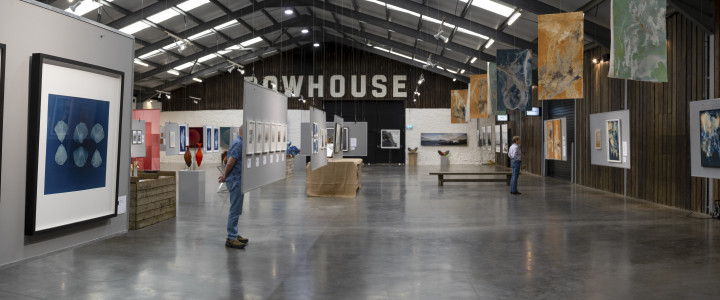
Artist Paul Kenny is sitting on a fold out chair in the huge, hangar-like environs of the main hall at Bowhouse; a farm-shop complex in Fife. Converted into a gallery space for the duration of the group exhibition Space to Breathe: Land & Sea, the echo-filled hall contains several rows of extraordinary hanging prints, including Kenny’s own, many of which seem to sit somewhere between speculative Martian planetscapes and chance-based expressionist paintings. He passes round several little squares of glass with splattered and scalloped seawater patterns on them to a small audience.
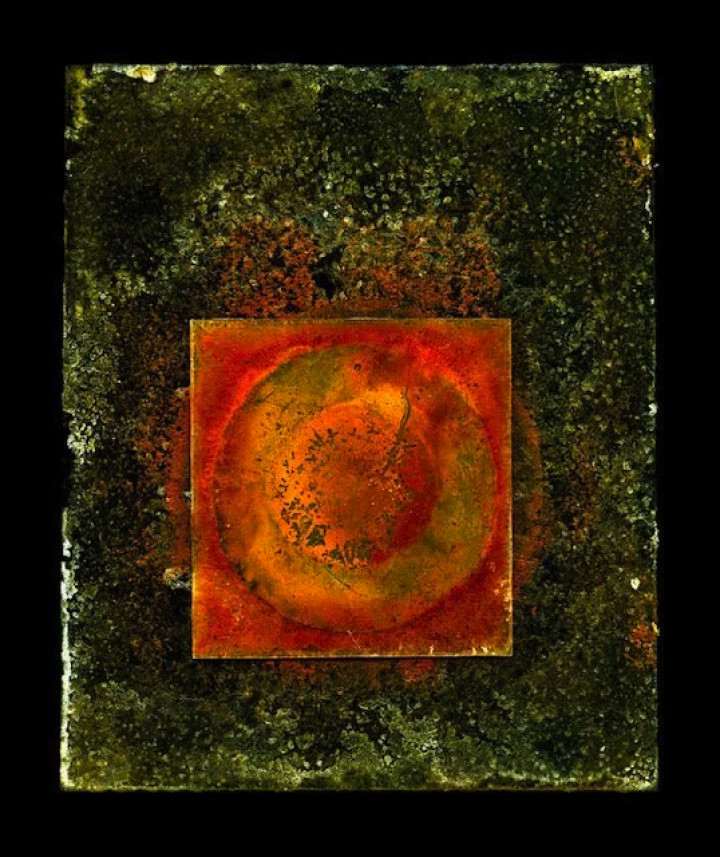 Paul Kenny. Rust Never Sleeps. Downpatrick Head No. 6 (2009). Courtesy of Studies in Photography © The Artist.
These little smudged, opaque panels are the basis for some of Kenny’s photo-prints. Gathering up seaside detritus of all kinds, Kenny combines these with briny water and other liquids and chemicals, and exposes his gatherings of waste objects and liquids to sunshine over light-sensitive surfaces, across variable stretches of time. His results have to be seen close up to be appreciated: colours of extraordinary richness, crystalline salt-crust patterns suggesting ferns and fractals.
There is no one set way that Kenny, born in Salford in 1951 and now based in Newcastle, creates his photographs. But a factor uniting much of his practice, like much of the work in Land and Sea, is the absence of a camera. And why not? Photography, the technology of creating permanent, visible marks on light-sensitive surfaces, predates the invention of the camera by decades, stretching back to the late-eighteenth-century experiments of chemists Thomas Wedgwood and Humphry Davy. As the pioneer of modernist cameraless photography or “photograms” László Moholy-Nagy put it, “the essential tool of the photographic process is not the camera but the light-sensitive layer.” Indeed, the etymology of the term, coined by Victorian scientist John Herschel, is in the Greek words phos (“light”) and graphe (“writing” or “drawing”). Photography is simply drawing with light.
The most beautiful historic variant of cameraless photography is the cyanotype, a method developed by Herschel involving a surface coated in an iron salt solution exposed to ultraviolet light then washed with water. The resulting Prussian-blue hues are best-known from the plant specimen prints of Anna Atkins, a botanist and contemporary of Herschel’s. But the medium is alive and well and in evidence in Fife, not least in the work of Alexander Hamilton (b.1950), a co-organiser of the current exhibition, which expands on Without A Camera: 200 Years of Photography 1826- 2026, a group show held at Hamilton’s Edinburgh-based Studies in Photography gallery earlier this year.
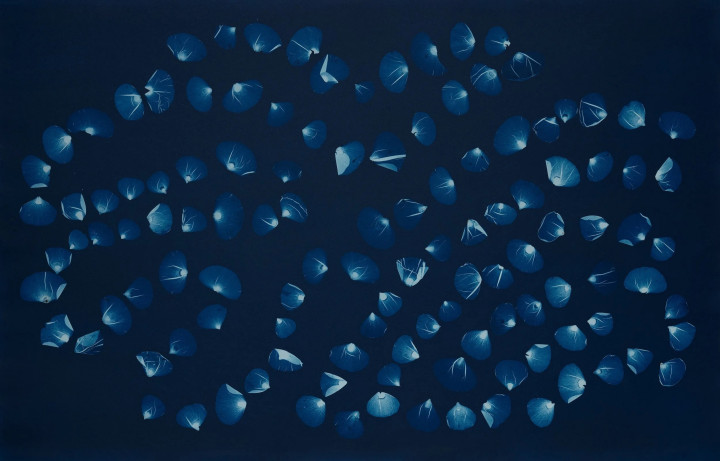 Alexander Hamilton. Pishwanton Cyanotype. Courtesy of Studies in Photography. © The Artist.
As Alexander Moore puts it in an essay accompanying that show, Hamilton uses the cyanotype as “a way of paying sustained attention to the natural world....Flowers, leaves and grasses are placed directly on sensitised paper and exposed to sunlight, yet the resulting images function as more than botanical studies.” Moore notes Hamilton’s recurring presentation of the “motif of the Blue Flower, drawn from Romantic literature and later echoes in the writings of Ruskin and the work of Joseph Beuys,” a symbol of “curiosity, knowledge and the search for a deeper relationship with the living world.” Hamilton’s works have an almost spiritual vividness and precision to them: they transcribe nature in a way that seems immaculate, unmediated. The huge, rain-washed plant-fragment cyanotype called Pishwanton (1992), alludes to some of the philosophical underpinnings of Hamilton’s oeuvre, reflecting his time at the Goethean Science-inspired Life Science Centre at Pishwanton Wood near Haddington.
Elsewhere in the exhibition, the cyanotype method is adapted to the ends of ecological activism in the work of German-Irish photographer Andreas Scholz (b. 1981). Scholz’s stunning series ‘And So I Watch You From Afar’ uses polluted seawater during the exposure process to create works visibly marked by both salt residue and effluents. With their violent ochre and blue contrasts, they waver, like Kenny’s work, between evocations of otherworldly landscapes and abstract mark- making. The added dimension, though, is that Scholz’s work carries in its final form a record of the damage done to the natural materials used to create it. As a document of violence, it is almost like the remnants of an auto-destructive happening, in the style of Gustav Metzger.
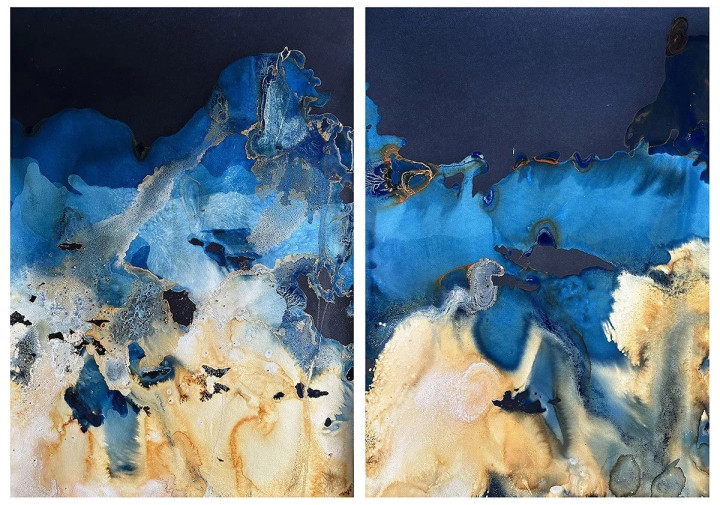 Andreas Scholz. And So I Watch You From Afar. Courtesy of Studies in Photography. © The Artist.
So much more could be said about the artists included in Land and Sea, not least the Scottish artist Constanza Dessain’s (b. 1986) marvellous ‘Meadow Skins’ prints. Placed alongside and establishing a dialogue with Scholz’s images, they are created through pressing weeds such as dock, sticky willie, and ragwort onto paper sensitised with iron salt. The plants release what Moore memorably calls “an image of themselves,” as the sap bleeds into the light sensitive chemicals, forming a kind of spindly, tachiste orthography.
 2025 .jpg) Constanza Dessain. Reabsorbsion I-II (II) (2025). Courtesy of Studies in Photography. © The Artist.
Constanza Dessain. Reabsorbsion I-II (II) (2025). Courtesy of Studies in Photography. © The Artist.
Suffice it to say, this current show in Fife seems to reflect a new interest, uniting several generations of artists in Scotland and beyond, in analogue photography that requires intimate, tactile forms of engagement with (natural) subject-matter. Moore astutely frames this as a response to the saturation of our waking lives with quickly produced, ephemeral digital photography; cameraless photography returns us to the roots of the photographic medium in “direct encounters with the physical world.” There is also, clearly, a concern with environmental sustainability wrapped up in this collective fascination.
Beyond cameraless photography, various events and exhibitions across Scotland indicate a broader interest in what might be termed “eco-photography.” The Sustainable Darkroom is a self-described “artist-led, research community that develops low-toxicity chemistries and practices in photography,” founded by Hannah Fletcher in 2019 and run with Edd Carr. At a recent event at Fruitmarket, Edinburgh, Carbon – Chemical – Curse, Fletcher and Carr were joined by locally based artists Scott Hunter and Jess Holdengrande, to discuss Hunter and Holdengrande’s approaches to reclaiming “a photographic commons.” This had to do with rejecting the use of harmful chemicals, cutting ties to carbon-polluting industries, and avoiding mass-consumption photographic formats.
Elsewhere, the exhibition Flow: From Research to Restoration, at John Muir’s birthplace in Dunbar includes plant-based photographic prints alongside Japanese Dorodango sculptures (polished balls of mud and water). The Irish photographer Zoe Hamill, meanwhile, has been working with the community arts charity Craigmillar Now to design a “darkroom garden” and deliver seasonal photography workshops.
At the core of many such projects are the closely entwined aims of extricating photography from the spiralling demands of the attention economy, and reestablishing a sense of wonder at the natural world. In so doing, much cameraless and eco-photography updates Moholy-Nagy’s credo for an age of ecological crisis. If the austere, Bauhaus-trained radical opposed the “Pictorialism” of a previous generation because he wanted photography to serve as an abstract record of invisible scientific processes, the artworks of Kenny, Scholz, and others invite a more empathetic, Romantic form of attention to what is intangible, hidden. They invite us to muster new kinds of reverence for a natural world at risk of erasure from our screens.


