
Scottish Art News
Latest news
Magazine
News & Press
Publications
Kate Walton: Alone together
By Greg Thomas, 12.10.2026
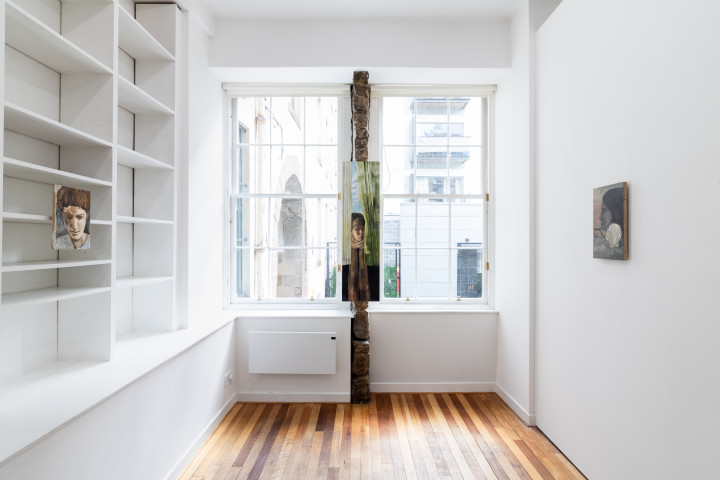
Kate Walton’s solo exhibition One with Others marks out a strange and disarming expressive space. Immersed in Post-Impressionist and early-Renaissance colour and composition, the Halifax-born painter brings historically-minded reference-points to poignant and oddly uncanny studies of contemporary isolation. A female figure gazes out impassively out from between two inexplicably mismatched curtains in ‘Window Figure’ (2026); in ‘Reclining Figure’ (2026), a robed, supine form stretches out across a rocky backdrop that seems to stretch off to a blank horizon. A gently dreamlike quality pervades these thin slivers of picture-plane.
Speaking from her studio in Trongate, Walton, who studied in Leeds and Brighton during the late 2010s, explains that her formative experience was the 16 months she spent at London’s Royal Drawing School in 2022-24, specifically “the conversation I had with the history of painting during that year.” The rigour of the training also seems to have helped: “there were classes from ten in the morning until nine at night”. And Walton was also able to steep herself in the collections of the nearby National Gallery: “on top of all the intensive drawing from life, you’re spending hours standing in front of paintings, learning about colour and composition.” It was in London that the artist learned to “make connections between different historical periods. I never really had that from art school previously.”
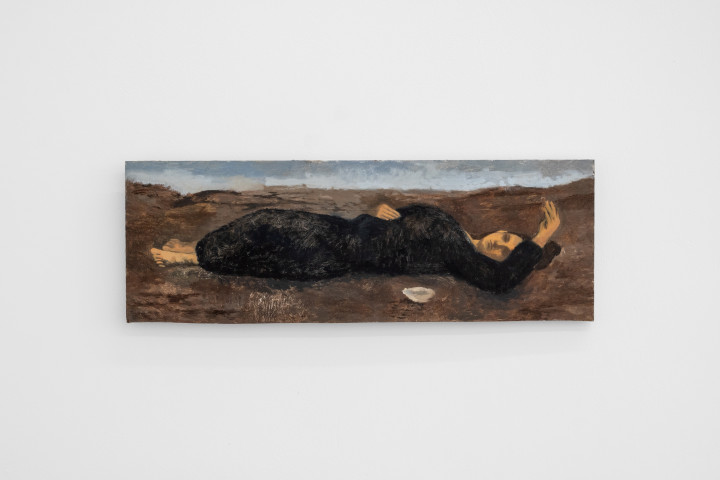 Kate Walton. Reclining Figure (2026). Image Courtesy of the Artist and 5b, Glasgow. Photos by Ben Seeley.
Drawing School tutor Timothy Hyman’s writing on fifteenth-century Sienese painting quickened a burgeoning interest in the early Renaissance gleaned from the strong holdings at the National Gallery: Piero della Francesca et al. Walton began to consider how three-dimensional space was depicted in this early vanishing-point-era work as compared to Post-Impressionism, with its strange manipulations of depth and volume. “I think Cézanne is just the greatest artist ever”, she laughs. Later generations of expressionists and post-impressionists, including canonical and more niche figures such as Gwen John, Marie-Louise von Motesiczky, and Paula Modersohn-Becker, help to explain the textured, painterly facture in some of Walton’s portraits, such as ‘Head with Shell’ (2026).
The atmospherics of these studies also owes something to their unique materials and means of production. In homage to Sienese School icon painting, Walton applies home-made gessoes to wooden board as the grounds for her compositions, giving them a gentle luminosity reminiscent of, say, a fourteenth-century altarpiece. Working part-time as a studio assistant at Glasgow School of Art, meanwhile, means regularly coming across oddly shaped or narrow strips of discarded timber. At a certain point, these offcuts began to strike Walton as suitable frames for exploring the slipperiness and trickiness of illusory space. “Are they cross-sections of a larger volume, or is the space of the painting just within that narrow shape?”
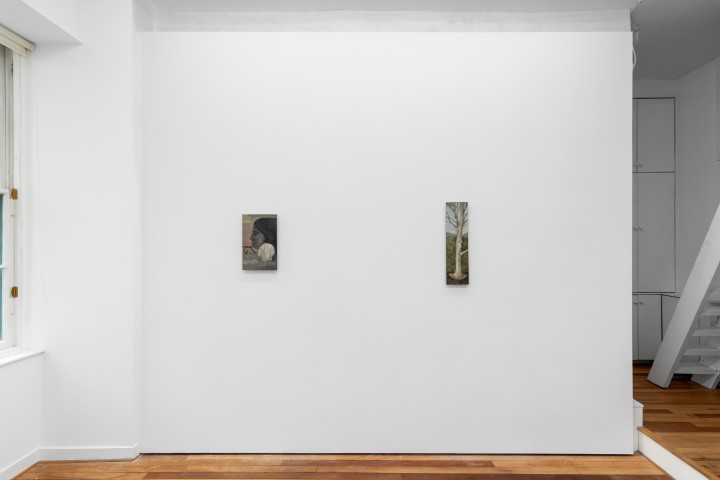 Kate Walton. One with Others. Image Courtesy of the Artist and 5b, Glasgow. Photos by Ben Seeley.
Walton’s portraiture is able to marshal these timeworn influences to present a very contemporary feeling of isolation. This perhaps has something to do with the affectless expressions of her subjects, and something to do with a mode of composition that often involves a subtle collaging of elements, such that each part of a composition appears curiously alienated from the rest. In what is perhaps the standout work of the show, ‘Window Figure’, the female subject gazes out from between green and white curtains which seem to have been sampled from different, but similar, scenes. Likewise, in ‘Head with Shell’ (2026), a face in profile and scallop shell are brought together in a way that has an element of dream-logic bricolage to it.
There is, in short, a kind of emotional fracturing at work in Walton’s practice which is oddly redolent of a post-Covid, digital-age loneliness. It will be fascinating to see the new forms and atmospheres that emerge from her paintings over the next few years. For now, this show at 5b provides a fascinating introduction.
One with Others, running at 5b in Glasgow until 7 November 2026


