
Scottish Art News
Latest news
Magazine
News & Press
Publications
From the Earth: Interview with artist and curator Siobhan McLaughlin
By Jelena Sofronijevic, 08.04.2026
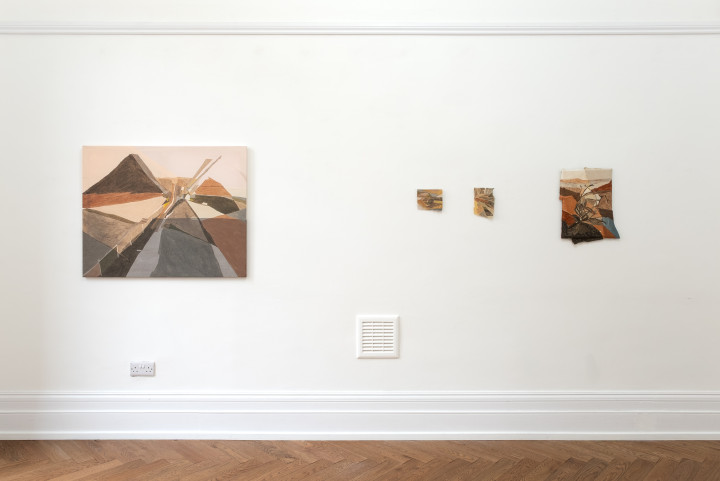
Glasgow-based artist and curator Siobhan McLaughlin works with remnant textiles and gathered earth pigments to create paintings, prints, and installations. Her work will feature in Jupiter Artland’s upcoming group show Extraction, alongside Carol Rhodes, John Latham, John Gerrard and Marguerite Humeau. The exhibition explores how energy systems shape culture, land, and belief. The artists’ practices are not only brought in conversation with each other, but Jupiter’s own layered landscape, where traces of the shale gas industry, North Sea petroleum economy, and contemporary renewables are simultaneously visible. Jelena Sofronijevic met with McLaughlin in Cornwall, ahead of the exhibition’s opening.
Jelena Sofronijevic (JS): Much of your work directly draws from ‘derelict land’ which, when translated into and from Scottish Gaelic, returns to the English language as ‘growing land’. Could you talk about your understanding of derelict land in Scotland, and the potential of artistic practice - as a visual language - to affect change in our perceptions of it?
Siobhan McLaughlin (SM): For several years I’ve been sewing remnant textiles as a base for painting, and gathering earth – from ancient ochres in riverbeds to earth stained by mining waste – to create paint that speaks to the land’s ability to hold knowledge and memory. This interest in how past and current activities leave impressions on our ecologies, led me to explore post-industrial landscapes and derelict land in Scotland. Previously I’ve explored the Cromarty Firth, which has become a watery graveyard for de-commissioned oil rigs, whilst works for my recent solo show in Glasgow were developed from research into the paraffin oil industry in West Lothian.
My painting practice has led me to constantly look for colour in the landscape. Even as a child, I was intrigued by the pink-red hills that I’d glimpse through the train or car window on the journey between Glasgow and Edinburgh. I like the idea that through noticing colour and form in the landscape we can access knowledge, in a way that doesn’t require an academic degree or specialism. Researching these pink hills, which are in fact monumental heaps of waste rock that are remnants of the paraffin oil mining industry prominent in West Lothian from the mid-nineteenth century, and referred to locally as shale bings, I discovered more about derelict land.
Those in Scotland’s most socio-economically deprived areas are 55-88% more likely to live close to derelict land, compared to only 7% in the most affluent areas. This has a huge impact on community resilience, wellbeing, and connections to nature, which in turn affects how we address the climate crisis. Learning about the unique ecosystems of the bings has unlocked ideas of the hopeful potentials of derelict land: for nature and biodiversity but also growing communities. Through my painting practice I’m interested in the idea that, by using just a handful of shale or ochre deposits created by mining waste, ground into painting pigment, the work can speak about these many ideas of access, biodiversity, industrial action, pollution, disability, social and cultural histories.
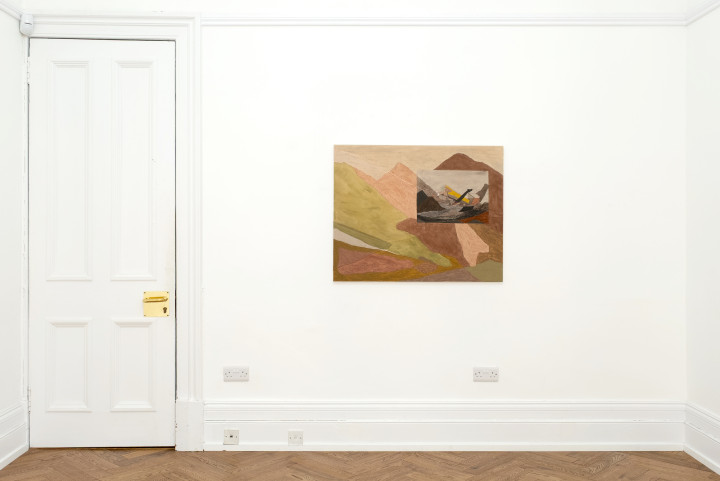 The Five Sisters install II 2025, © A_Place Gallery
JS: In a presentation of your work with Radical Ecology in Dartington, you evoked a memory of falling into black earth whilst gathering pigments. Art students are often told that black doesn’t exist as a colour, yet this features prominently in some of your works - perhaps reflecting how colour serves not only as a means to access knowledge, but to challenge conventional understandings and hierarchies of value.
SM: Yes. For most of my practice, I’ve avoided black paint, finding it an empty colour. But the black pulverised stone unearthed by new extraction works at the Five Sisters bing has been fascinating to work with. The connotations of it as a colour in relation to this site have been interesting to explore. Over time, the black oily shale of the Five Sisters went through a process of Primary Succession (where pioneer species like lichen and moss break down rocks to form soil, eventually allowing grasses, shrubs and trees to grow, building a complex and stable ecosystem) and oxidised, resulting in these brittle pink-red stones. Creating paintings with this stone, and other mining waste earth pigments from Cromarty, Leven or South West Cornwall, has developed a colour palette that viewers don’t immediately link to the Scottish or Cornish landscape. Painting my experience of landscape with the earth of that landscape, I’m interested in asking viewers what is held within our land if we slow down to look.
The Scottish Vacant and Derelict Land Survey also codes areas of derelict land by colour, with green classified as 'Developable - Short Term', meaning potential for residential or industrial uses' and red as 'Uneconomic to Develop/Soft End Use'. It's interesting to consider the positive/negative connotations of these red/green designations, which are based on economic priorities over community and biodiversity. Despite the negative connotation of the red categorisation, this actually means that the land is ideal for less intensive uses, like green spaces and community gardens.
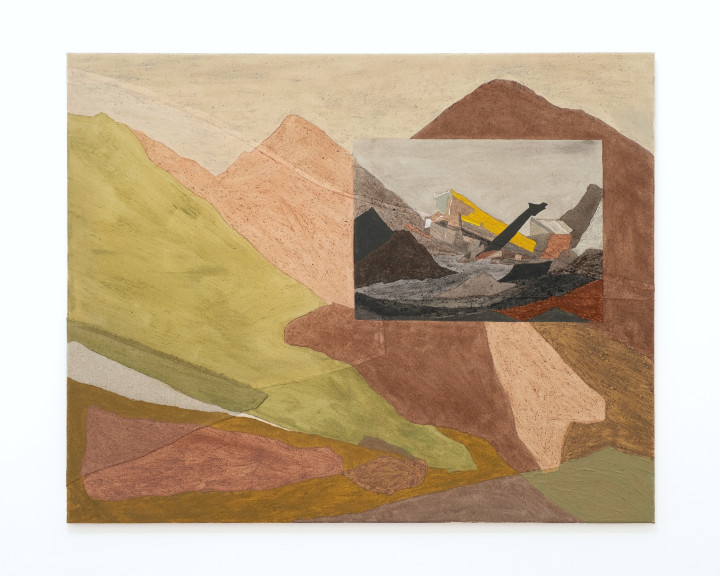 Date of Exhaustion, 2025, 80 x 100 cm, earth pigment from Five Sister shale, earth pigment from Gunwalloe, oil and acrylic on sewn remnant materials. © Sam O'Donnell.
JS: I am reminded of the work of fellow Glasgow-based artist, Tanoa Sasraku, and also the textile designer, Bernat Klein. Indeed, it was your curatorial work at Dovecot Studios which first brought you to Jupiter Artland, through your work on Alan Davie: Beginning of a Far-Off World in 2022. You have also curated an exhibition at Papple Steading in East Lothian, on view concurrently with Extraction. With respect to your work in the visual arts across Scotland, do you find you have a more curatorial relationship with Edinburgh, and artistic one with Glasgow, and why?
SM: Glasgow has a great artist-led scene but it’s potentially because I studied MA Fine Art at Edinburgh College of Art (ECA) and built an understanding of the art scene there that I often work in Edinburgh. Davie and I both studied at ECA (80 years apart), and he had collaborated with Dovecot, so it made sense for the exhibition to be there. Now I’m working with the newly opened Richard Demarco Gallery at Papple Steading, combining contemporary and modern art practices from across the UK and Europe with agricultural heritage in a restored ancient farmstead, echoing the energy of Demarco’s legacy of curatorial projects.
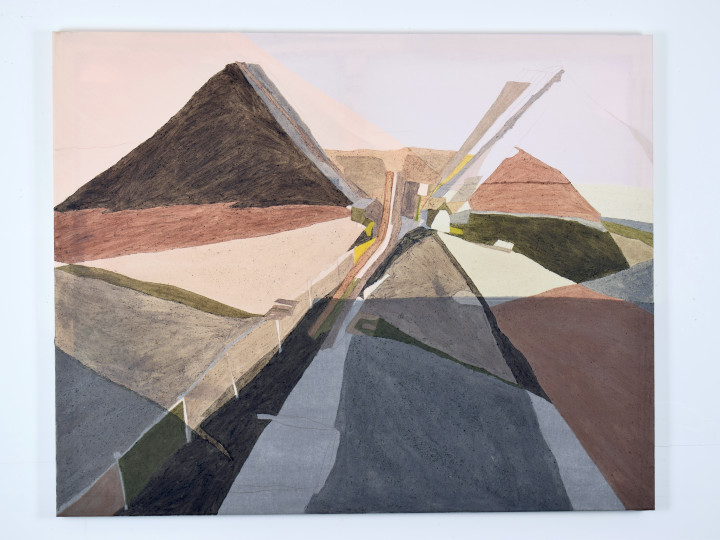 No More Tip Men, 2025. Earth pigments from Five Sisters shale, earth pigment from Gunwalloe and oil paint on sewn remnant materials, 80x100cm. © Sam O'Donnell
JS: In Extraction, your work features alongside artists including John Latham and, whilst you are interested in the Artist Placement Group (APG), there is a marked difference in your working with and for communities. Could you talk about your relationship with Latham, and some of the practitioners (and women) in Scotland who have informed your approach?
SM: I have always liked the idea that artists can have agency and create agency for others. Or that art can be a way to access, expand, or disrupt existing knowledge and conversation.
Latham’s 1975 Artist Placement Group (APG) work with the Scottish Development Agency was interesting to learn about as a student, thinking how artists could dislodge bureaucracy or think about civil issues from a different angle. I really like John Latham’s work on the bings, how he changed their purpose Through his designation of the bings as monumental process sculptures, he was key in preserving them. To be honest, I’m amazed to be exhibiting with him, and with Carol Rhodes, who has been a huge inspiration for years.
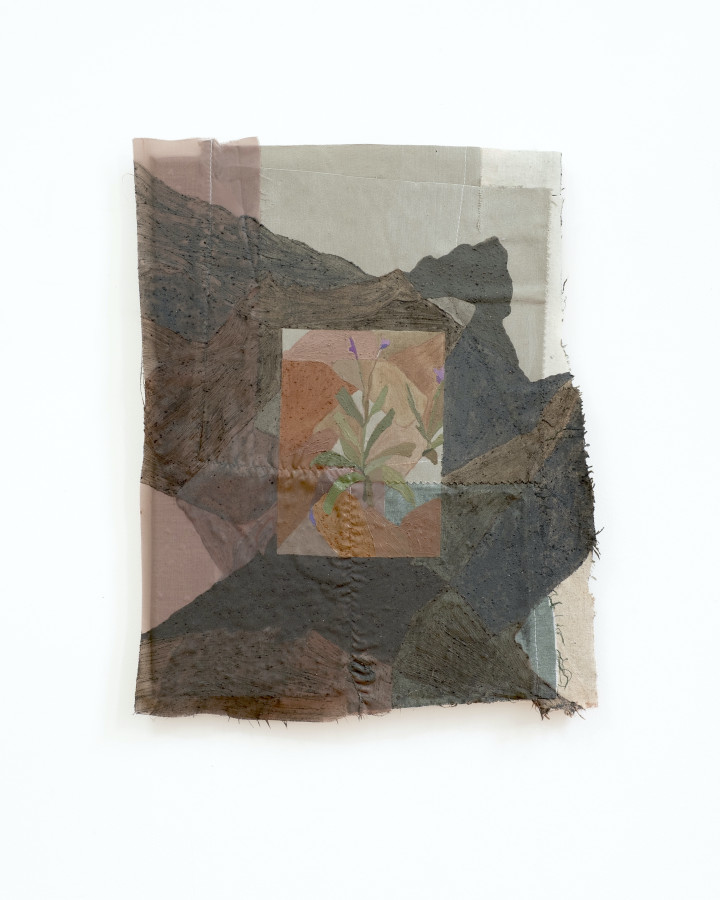 Pioneer Species, 2025, earth pigment from Five Sister shale, and acrylic on sewn remnant materials, 42 x 31 cm.
Still, I find Latham’s ‘enchantment’ with the bings and his ‘interest in the unconscious design’ a bit difficult, as the design was conscious: the oil companies were meticulous in their the ‘date of exhaustion’ of the land. The Five Sisters have industrial struggle in their form, as due to labour strikes due to pay and dangerous conditions, the oil company developed new mechanised processes that meant workers lost their jobs. Instead of the lumpy bings built cart by cart, the Five Sisters uncannily pass as natural hills, though they are anything but.
The romanticisation of Celtic landscapes has, for centuries, led to the minimising of the land’s and I both reflect on and challenge this through my practice.
Extraction opens at Jupiter Artland 11th April and runs until 26th July


