
Scottish Art News
Latest news
Magazine
News & Press
Publications
Celebrating International Cat Day with Two Works from The Fleming Collection
08.08.2026
In Alexander Roche’s painting ‘A Newhaven Fishwife’ (1901) a woman stares directly at the viewer, standing upright and bearing a heavy basket of fish on her back. The Newhaven Fishwives were popular subjects of portraits during the early 20th century, and known for their beauty and confidence. The women often advocated for their husband’s livelihoods, often describing that the more fish sold the less their husband needed to participate in the dangerous activity, therefore supporting the family as a whole.
While the fishwife in Roche’s painting represents women’s power in fishing societies and the family unit, so does the young girl and the black cat in the image. The young girl also carries an armful of fish, possibly representing her family’s portion of the catch or her future as a fishwife. She looks towards the black cat, which arches its back and brushes up against the wall of the building. The cat’s tail is stretched up in a friendly manner. The blue ribbon and the cat’s full belly suggest it may be a pet. There is a suggestiveness to the cat’s hooded eyes that also alludes to a mischievous nature.
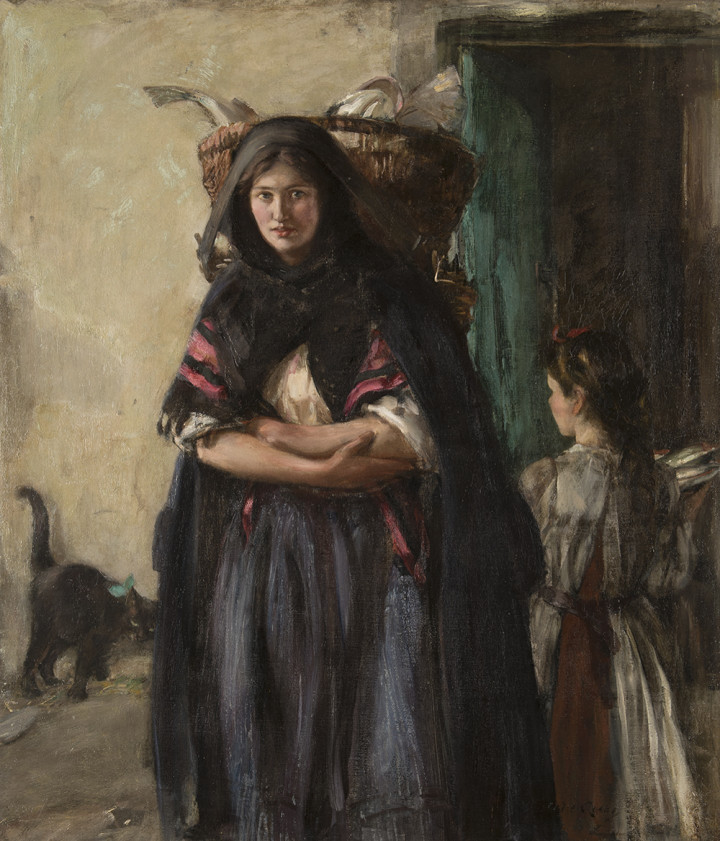 Alexander Roche. A Newhaven Fishwife (c. 1901). The Fleming Collection.
Black cats in Celtic and Gaelic legends were viewed as possessing supernatural powers and being witches’ familiars, or even witches themselves in animal form. Witchcraft was a crime in Scotland and between 1563 until 1736 women who seemed mysterious or fell outside society’s expectations were targeted and executed. Cats had a similar mysterious and independent nature that made people associate them with these women, which extended into legends like a Cat Sith who was a witch able to transform into a cat up to nine times. It was also believed cats could even be studied in coastal areas to predict storms. Roche’s black cat may suggest these supernatural powers are connected to the successful catch the fishwife carries.
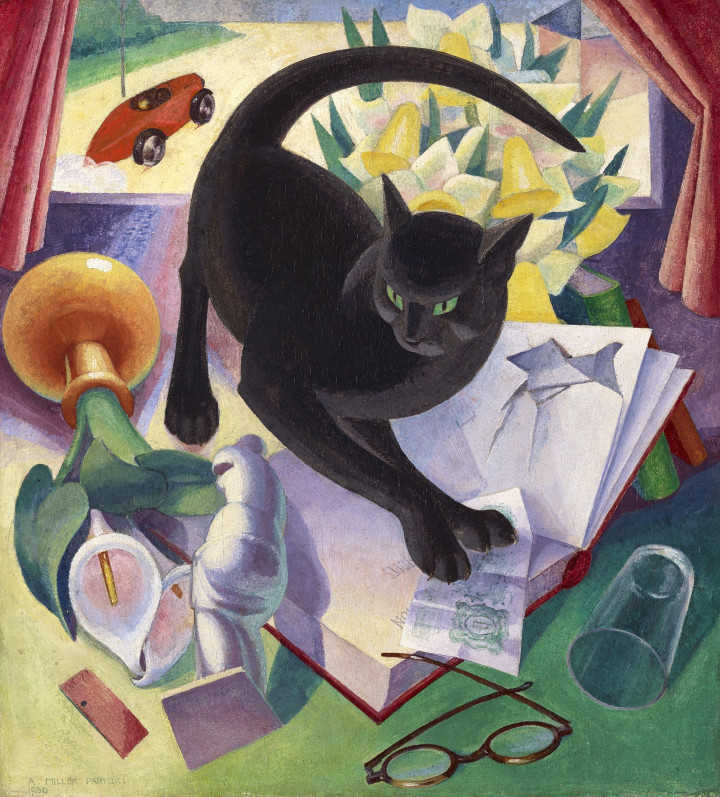
‘The Uncivilised Cat’ by Agnes Miller Parker presents the truly mischievous nature of black cats. In contrast to the cat in Roche’s painting Parker has painted this black cat with a raised tail and pinned back ears, suggestive of its defensive nature as it scratches up a bank note. Art historians have connected this piece to presenting Parker’s feelings over her tumultuous marriage with Scottish artist William McCance. The open book with a torn page depicts Marie Stopes’ novel ‘Love’s Creation,’ which describes the relationship between men and women particularly in the 1920s. Women were gaining independence during this period, earning the right to vote in 1928, and feminist ideas were becoming a topic of focus in paintings.
Through the black cat, Parker begins to express her own interaction with feminism. The act of scratching up the bank note suggests this cat, as an extension of Parker herself, seeks financial independence. The fallen bouquet of lilies and the overturned statue of Venus go further to show the rising tensions in Parker’s marriage. The title in combination with the black cat’s disruptive nature displays the obstacles women faced at the time to achiever social and financial independence.
Black cats certainly hold an important role within Scottish art of the early 20th century. From symbolism through folklore to contemporary discussions of feminist movements, black cats are presented in paintings as mischievous and mysterious. They form extensions of the feminine self, becoming an avenue to express women’s desires within Scottish paintings during periods when women were still being silenced or stigmatised. Today, black cats are our loyal companions, who have full bellies like the cat in A Newhaven Fishwife, c. 1901 and are playful like The Uncivilised Cat, 1930.


