
Scottish Art News
Latest news
Magazine
News & Press
Publications
A City’s Wellspring: Joanna Kessel on her new public artwork for Glasgow
By Greg Thomas, 07.07.2026
I arrive, sweaty and steaming after cycling through the tepid rain, at Glasgow Cathedral, where artist Joanna Kessel is waiting to show me down flights of shallow stone stairs, past little throngs of muttering tourists, to St. Mungo’s Well, tucked away in the south-east corner of the crypt. It is cool down here. Voices echo in several languages as visitors mill past a gently glowing, blue-green opening in the ancient buttress wall. Some stare in, gasp, smile, throw coins. At one point in our interview I ask Joanna if she likes observing people like this. ‘Yes, I find it very emotional.’
This the site of Wellspring, an extraordinary new public artwork created by Edinburgh-based mosaicist Kessel and commissioned by the Glasgow-based arts collective Aproxima, with financial backing from copious sources including Glasgow City Council, via their G850 fund to mark the city’s 850th anniversary. When exploring the site with Aproxima’s founder Angus Farquhar at the start of the commission-period in late 2024, Kessel recalls, ‘Angus turned to me and asked me what I now refer to as that question: “if you could do anything here, what would you do?”. I said “I’d line St. Mungo’s Well with gold leaf mosaic”.’
visible cities alba (dawn)_1800x1500x30mm_gold leaf mosaic, jesmonite, pigment_2019_shannon tofts_sm.jpg) Joanna Kessel. (In)visible Cities Alba (Dawn) 1800x1500x30mm. Gold leaf mosaic, Jesmonite, pigment (2019). Shannon Tofts. Courtesy of the Artist.
Joanna Kessel. (In)visible Cities Alba (Dawn) 1800x1500x30mm. Gold leaf mosaic, Jesmonite, pigment (2019). Shannon Tofts. Courtesy of the Artist.
A year later, in December 2025, the finished work was unveiled in all its dappled glory, just in time to mark the centenary. But to tell the story properly, we need to turn the clock back. In 2019, Kessel made two large-scale abstract constructions for the Collect international craft fair at Saatchi Gallery in London. They incorporated glass mosaic tiles with inset gold leaf hand-made by Orsoni, the last glass furnace operators on Venice’s main island, and specialists in coloured mosaic glass or smalti. These pieces were inspired, Kessel tells me, by Byzantine mosaic, which uses inset gold-leaf to brighten ecclesiastical interiors, a myriad of which can be found in Venice and Ravenna.
‘The individual tesserae can be put in at angles to reflect and refract the light. There’s a scintillating effect within these darkened spaces, a liveliness we respond to in a visceral way...I always get a real sense of uplift, of wellbeing.’ The Venetian architect Carlo Scarpa (1906-78), whose mid-century minimalist aesthetics often included abstract mosaic inserts in concrete facades, was another touchstone.
Farquhar was introduced to Kessel’s work via these pieces just as he was looking for a collaborator who would respond to the site of Glasgow Cathedral’s well. As its name would suggest, the story of St. Mungo’s Well is enmeshed with legendary biography of Glasgow’s patron saint, and with the resultant growth of the city through the pilgrimage trail. Mungo is reputed to have established outdoor baptisms during the sixth century using the Molendinar Burn (a small tributary of the Clyde now culverted beneath the city’s streets). A site of both Christian and Pagan worship, the well built there was enclosed within the cathedral walls in the thirteenth century, in an attempt to cajole the worshippers of the old gods to the new.
.jpg) Selecting glass plates At Orsoni. Sept25. Joanna Kessel. Courtesy of the Artist.
Selecting glass plates At Orsoni. Sept25. Joanna Kessel. Courtesy of the Artist.
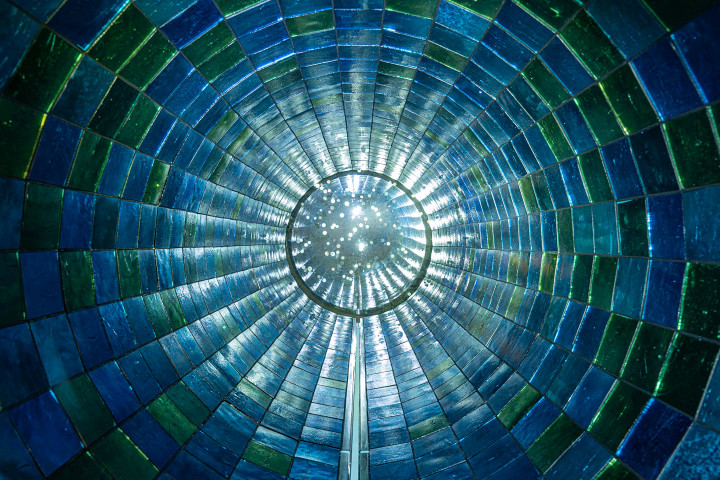
It was while walking her dog in the less formally sanctified environs of East Lothian’s forests that Kessel began to think about the atmospherics and aesthetics of outdoor baptisms and nature rituals, and devised a design that would combine them with the passion for gold-leaf mosaic expressed in the 2019 works presented at the Saatchi Gallery. She had become fascinated by the blue-green glass backs of Orsoni’s tiles (they are created by sandwiching a sliver of gold leaf between two layers of glass, one thick, one microscopically thin to display the gold facade). What if the reverses of the tiles were displayed rather than the fronts?
Through sketches and mock-ups, Kessel found her final design, an abstract pattern suggesting light dappling through foliage and sparkling on water below, with a rough shift from green to blue as the eye traces downwards. The issue now became how to insert a 2.7 metre cylinder, lined on the inside with 957 precious tiles, into a medieval well with scheduled monument status, that could not be damaged or altered in any way. In telling this story, Kessel refers continuously to the project as a collective one, involving Farquhar as creative director, James Johnson as lead designer, Dolly Dean as producer, structural engineers Narro Associates, and an installation team from Glasgow-based Sculpture and Design Ltd.
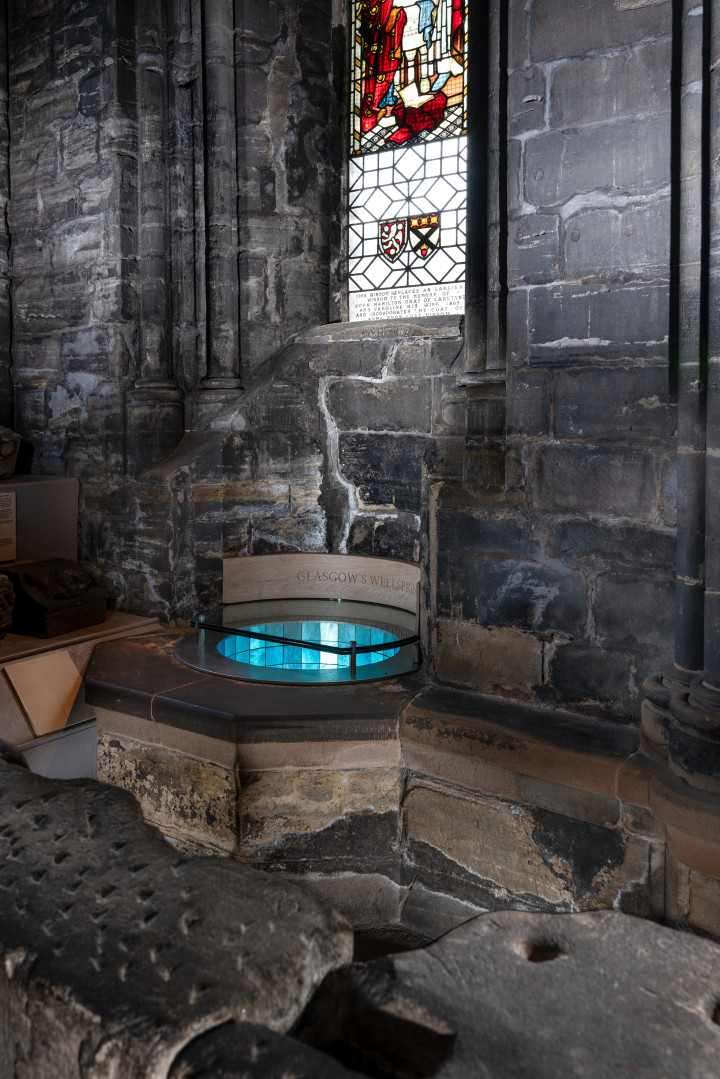 Glasgow's Wellspring Aproxima. Courtesy of the Artist.
Between them, this group devised and executed a plan involving a kind of upside-down, top-hat structure, a metal brim holding the work in place over the opening while the main structure hangs down inside. No part of it, remarkably enough, touches the walls of the old well. The most headline-grabbing aspect all this was the involvement of TRB Lightweight Solutions, who used cutting-edge aerospace technology to create a super-lightweight, super-strong, aluminium honeycomb structure for the cylinder. The company’s other projects include the CERN Large Hadron Collider.
The immediate effect of the artwork, however, belies the extraordinary degree of planning and technical prowess that went into its creation. It offers a kind of embodied spiritual elevation, as the viewer leans over to take in the play of light on the turquoise walls from the still-flowing spring below, itself sparkling with new votive offerings: coins and trinkets. The gold-leaf is visible below the glass surfaces of the tiles, bringing a sense of depth and texture, as if seeing a riverbed below the water’s surface.
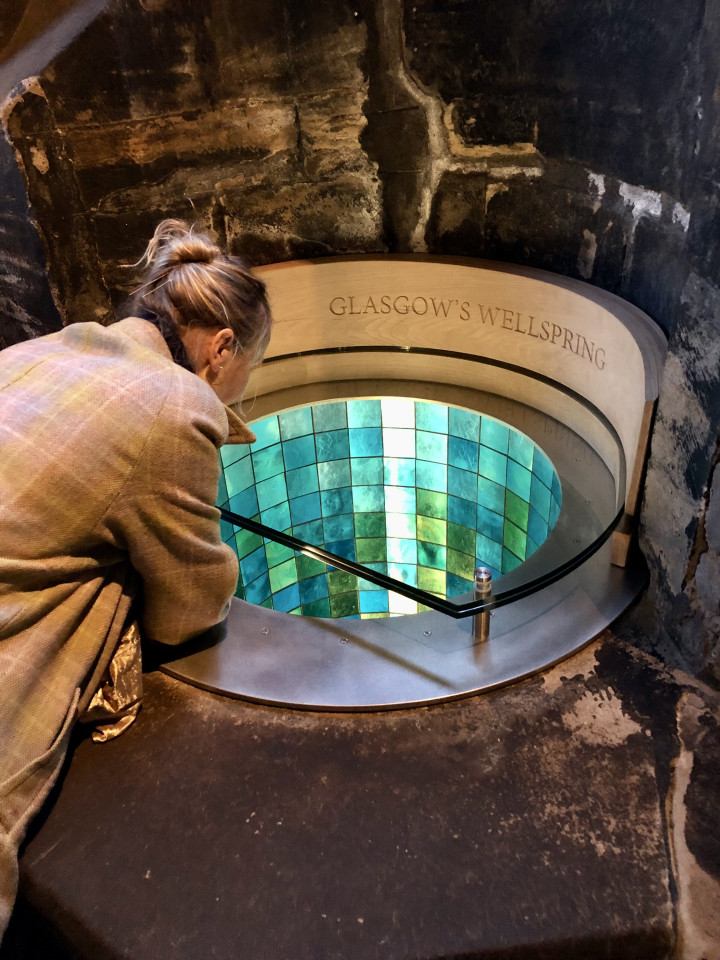 Peering down Glasgows Wellspring. Joanna Kessel. Courtesy of the Artist.
Later, we walk from Glasgow Cathedral to Glasgow City Heritage Trust, where the exhibition From Well to Wellspring provides a fascinating visual survey of the project, including carefully arranged rows of biros, sunglasses, and crisp packets, a little Martin Creed in effect, fished from the well-shaft.
On the way, Kessel talks about teaching mosaic in Le Marche and Emilia-Romagna, Italy. She notes the love for the craft across the country – ‘even if I’m in a small hill village talking to someone about what I do, and I tell them I make mosaics, there’s a real delight, and a sense of pride’ – and her connection with mosaicists in Ravenna, a historic hub for this ancient artform. ‘It’s a real privilege to have been welcomed there; I feel they have an understanding and an insight into mosaic that is different from the UK’.
Judging by the results achieved at Glasgow Cathedral, Scotland is lucky to be benefiting from Kessel’s own singular talents in this medium, notwithstanding the collaborative nature of Wellspring. It is a public artwork of lasting significance and immense beauty, a fitting homage to a city’s birth.
From Well to Wellspring is exhibited at Glasgow City Heritage Trust until 18 September


