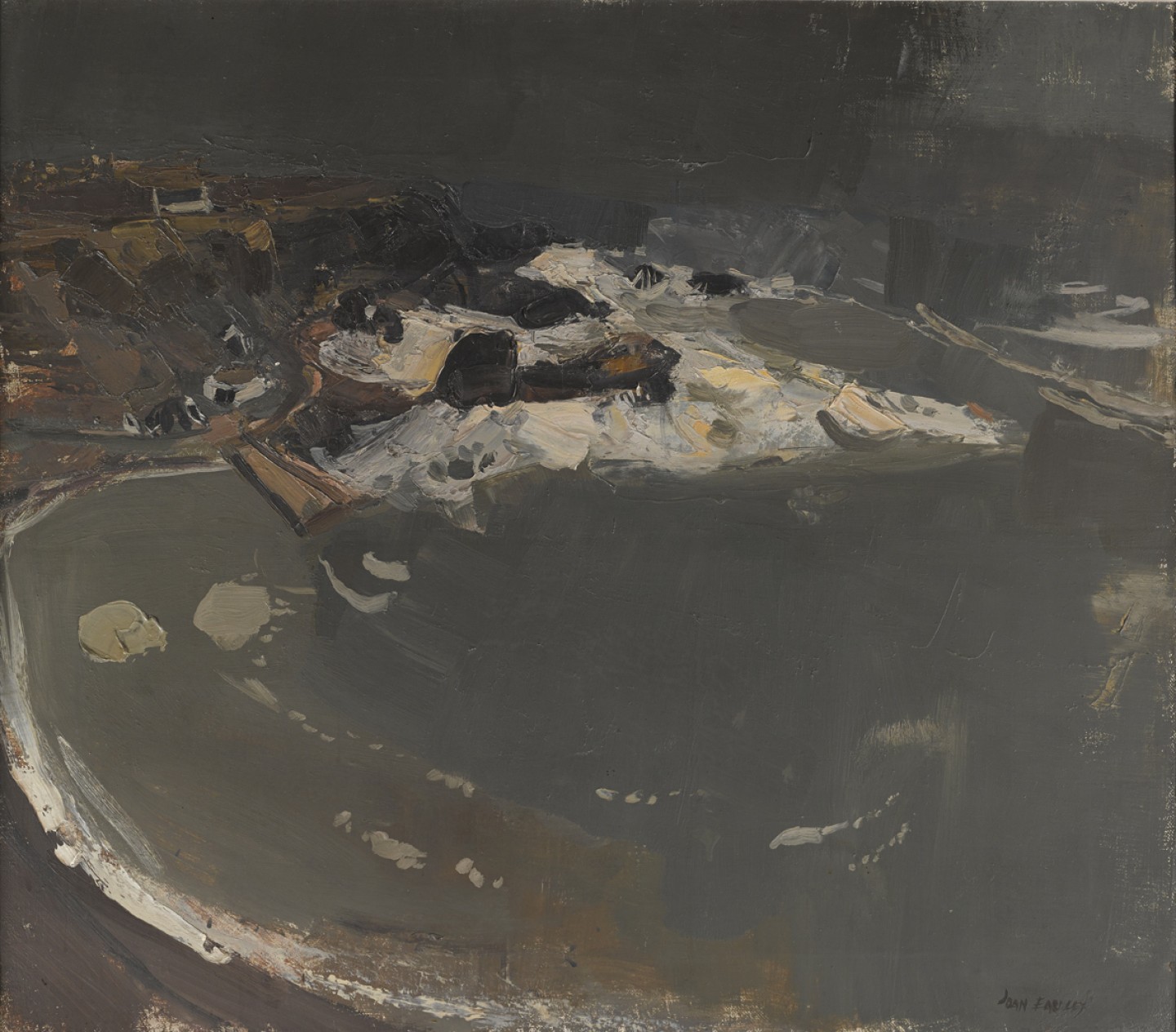
Wild Sea
Joan Eardley


DESCRIPTION
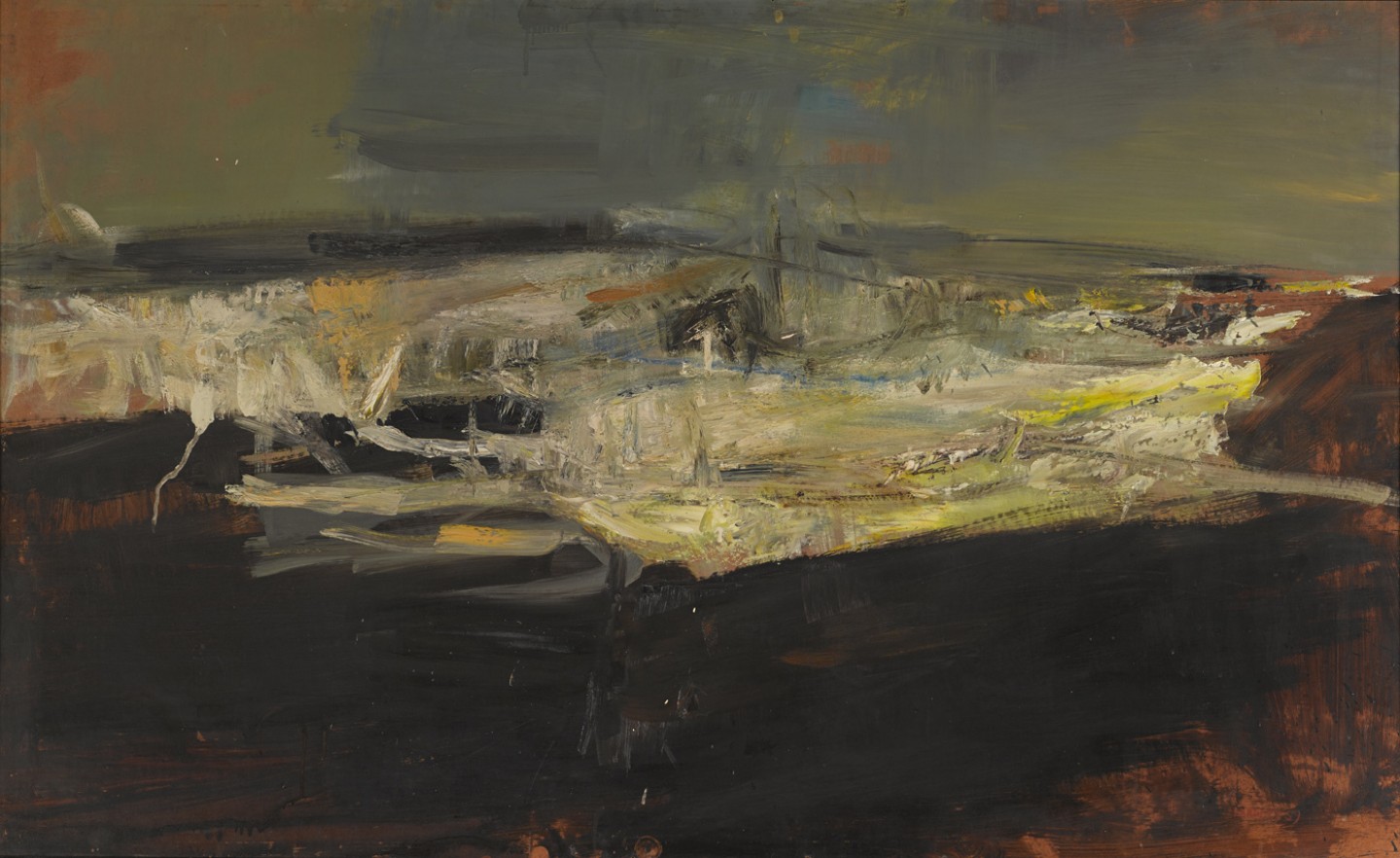
Wild Sea by Joan Eardley (1921-1963) depicts a coastline landscape in muted tones of brown, white, and grey. Where the waves crash against the rocks, Eardley uses thick, squared strokes of white with orange mixed in to create the movement and mark the only bright part of the painting. The coastline's cliffs are created through using thick layers of dark brown colour layed over lighter brown strokes. White structures can be seen loosely represented on the hilltop and closer to the shore, with a rectangular stroke of light brown and thinner, dark brown lines giving the impression of a dock on the calmer part of the shoreline. Sweeping strokes of grey create the calmer waters of the bay, with narrower lines of white showing the calmer waves hitting the brown shore. Similar to Eardley's other works, the dark grey sky and darker atmosphere of the painting reflects the intensity of the overall mood.
Later in Eardley's life, she spent half the year in Glasgow with the other half spent in Catterline painting fields, cottages, and coastline scenes such as this one. She had a fixation on the expressive storms along the coast, possibly a subject of this painting with the grey sky and overall moody atmosphere. Part of Catterline can be seen on the left side of the image, with its white fishing cottages and easy access to the sea. Eardley always painted on location, capturing the true sense of nature in its most chaotic element. Catterline became a favourite place of Eardley's and she spent her final few months of her life, as she passed away from breast cancer, in the village.
DETAILS
-
Artist
Joan Eardley
-
Date
c. 1958
-
Medium
Oil on board
-
Object number
278
-
Dimensions unframed
68 × 76 cm
-
Dimensions framed
90.5 × 98 × 7 cm
-
Place depicted
Catterline (2653496)
-
Marks
Signed bottom right
-
Copyright
© Estate of Joan Eardley. All Rights Reserved, DACS 2020
ARTIST PROFILE
Joan Eardley RSA, 1921-1963
Born in Warnham, Sussex, to Anglo-Scottish parents, and brought up in Lincoln and in Blackheath, London, Eardley studied art briefly at Goldsmiths College before moving to Glasgow with her mother and grandmother at the beginning of the Second World War. She trained at Glasgow School of Art under Hugh Adam Crawford before taking a wartime job as a joiner's labourer. In 1943 she graduated with both the Diploma prize for drawing and painting and the prize for portraiture.
Van Gogh, Vuillard and Bonnard influenced Eardley's early draughtsmanship and choice of domestic interiors. Henry Moore and early Italian renaissance masters brought a sculptural weight and humanity to the figure compositions. In 1947 Eardley resumed her art studies at Hospitalfield in Arbroath, under James Cowie, and the following year returned to Glasgow School of Art to pursue the post-diploma course awarded to her four years earlier. She was given two travelling scholarships and spent eight months visiting Paris, Venice, Florence, Siena and Rome. The sketches and compositions executed in France and Italy were shown at her first solo exhibition at Glasgow School of Art on her return in 1949.
In 1950 Eardley discovered the small fishing village of Catterline, near Stonehaven, Kincardineshire. From then on she divided her time between her studios in Glasgow and Catterline. The later gestural weather studies in chalk had much of the force of the Abstract Expressionists but never became totally abstract. The oils included collages layers of earth and vegetation under thick sweeps of paint.
A quiet, retiring person, Eardley pursued her art with single-minded purpose. Her style is individual and conforms to no particular schools. She was elected ARSA in 1955 and RSA in the spring of 1963 but died a few months later.