St. Monance
William Wilson


DESCRIPTION
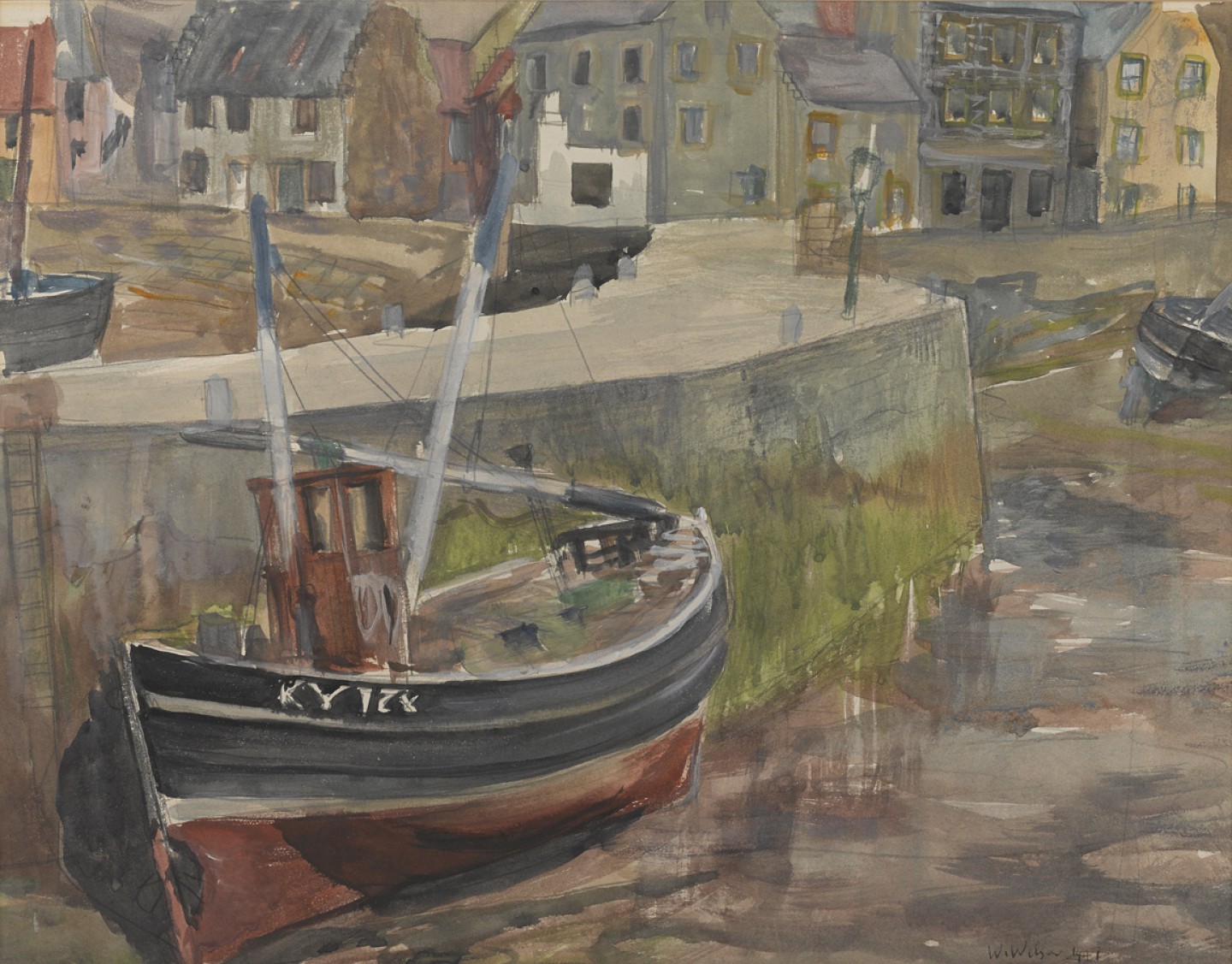
St. Monance by William Wilson (1905-1972) depicts a harbour at low tide, with a black and red ship resting against the harbour wall. Wilson uses layers of watercolour, working from light to dark colour, to capture the details of the algae covered walls and the roundedness of the ship's body, creating depth within the work that is otherwise flattened in the blocks of colour used for the houses in the distance. This applies intense focus on the ship in the foreground, as it remains in full focus while the background appears in less detail.
Wilson's study of stain glass likely influenced his approach in this work with the way the background is in singular, coloured block components that make up the overall structure of each building. He was well known was a watercolourist, reflective here with his strong ability to layer the pigments to capture depth within the work, using this technique to depict the many fishing ports he saw during his travels.
DETAILS
-
Artist
William Wilson
-
Date
1947
-
Medium
Watercolour on paper
-
Object number
930
-
Dimensions unframed
34.9 × 45 cm
-
Dimensions framed
62 × 71 cm
-
Place depicted
Saint Monans (2638719)
-
Marks
Signed bottom right
-
Subject
-
Copyright
Ⓒ The Copyright Holder
ARTIST PROFILE
William Wilson OBE RSA RSW, 1905-1972
Born in Edinburgh, Wilson started work with the map makers John Bartholomew & Son, and at the same time attended evening classes at Edinburgh College of Art. Adam Bruce Thomson, who was responsible for the college’s etching classes, recognised Wilson’s talent, and as a result he was enabled to attend full-time classes. In 1934 Wilson studied engraving and stained glass, opening his own stained-glass studio in Edinburgh three years later.
Wilson also excelled in printmaking and watercolour. He was superlative draughtsman whose etchings are reminiscent of Bruegel, and this draughtsmanship can be seen also in his watercolours. These works, which are based on a framework of pen-and-ink drawing, record scenes ranging from the fishing ports of Fife to Provence and Venice.