
Island of Handa, West Coast of Sutherland
James Giles


DESCRIPTION
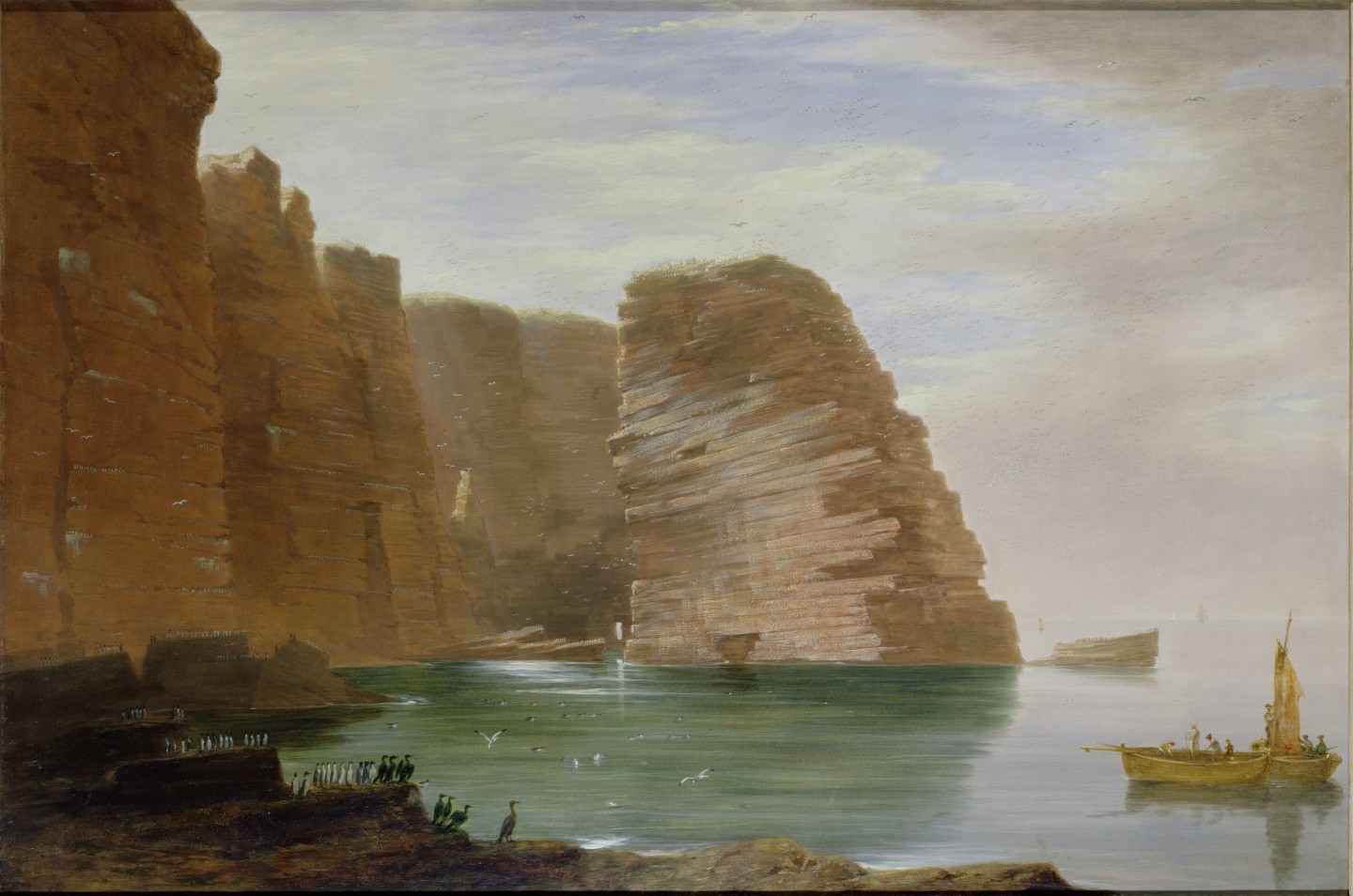
Island of Handa, West Coast of Sutherland by James William Giles (1801-1870) captures looming cliffs over a rocky coastline, with groups of birds on the coast and two small ships on the right side. Another small sailboat is in the distance beyond a smaller cliff, created with two thin strokes of paint and even further a larger, masted ship also created with a few brush strokes to create its shadow in the distance. The central cliff Giles captures in high level of detail with sharp, thin lines of dark brown colour capturing the edges of each layer of rock and the sharp corners. These details are accentuated by Giles then going back to add rectangular, dryer layers of white and yellow over the brown to add highlights and draw the eye into this leaning tower of rock. Delicate, v-shaped strokes of white paint show seagulls and other birds flying in large groups towards the cliffs. Even smaller flecks of paint show birds in the distance already resting on the cliffs. The figures on the ships and the birds in the foreground are captured in more detail and variations of colour, so much so that some of the birds can be made out to be guillemots and cormorants.
The level of minute detail in this piece of work, from the small strokes of paint creating groups of birds and the attention to detail in the varying shades of blue and green in the reflection of the cliffs on the water speaks to Giles's mastery of landscape painting, particularly with neo-classical influences. The lightness in the painting and delicate details speak to a harmony throughout the piece that reflects Neo-classical art movements. Even though Giles traveled much throughout his art education, he often chose Scottish landscapes as the subject of many of his paintings and many of these landscapes were commissioned or purchased by Queen Victoria.
DETAILS
-
Artist
James Giles
-
Date
Unknown
-
Medium
Oil on canvas
-
Object number
364
-
Dimensions unframed
61 × 91.4 cm
-
Place depicted
Sutherlandshire (2636507)
-
Subject
ARTIST PROFILE
James William Giles RSA, 1801-1870
Giles was born in Aberdeen and by the age of nineteen had succeeded his father, a textile designer, as a drawing master in that city. After marrying in 1823 he embarked on a period of study, first in London and then in the Paris studio of the Neo-classical painter Jean-Baptiste Regnault. This was followed by an extended tour of Italy, during which Giles executed more than a thousand watercolour sketches as well as copies of the Old Masters. On his return he and the Aberdeen architect Archibald Simpson founded the Aberdeen Artists' Society, of which Giles, as the city's leading landscape and portrait painter, was elected president.
As well as painting, Giles was interested in landscape gardening. In 1852 he was invited to submit perspective drawings for Balmoral Castle to Queen Victoria, and subsequently advised on the landscaping of the grounds.