Dollar
Waller Paton


DESCRIPTION
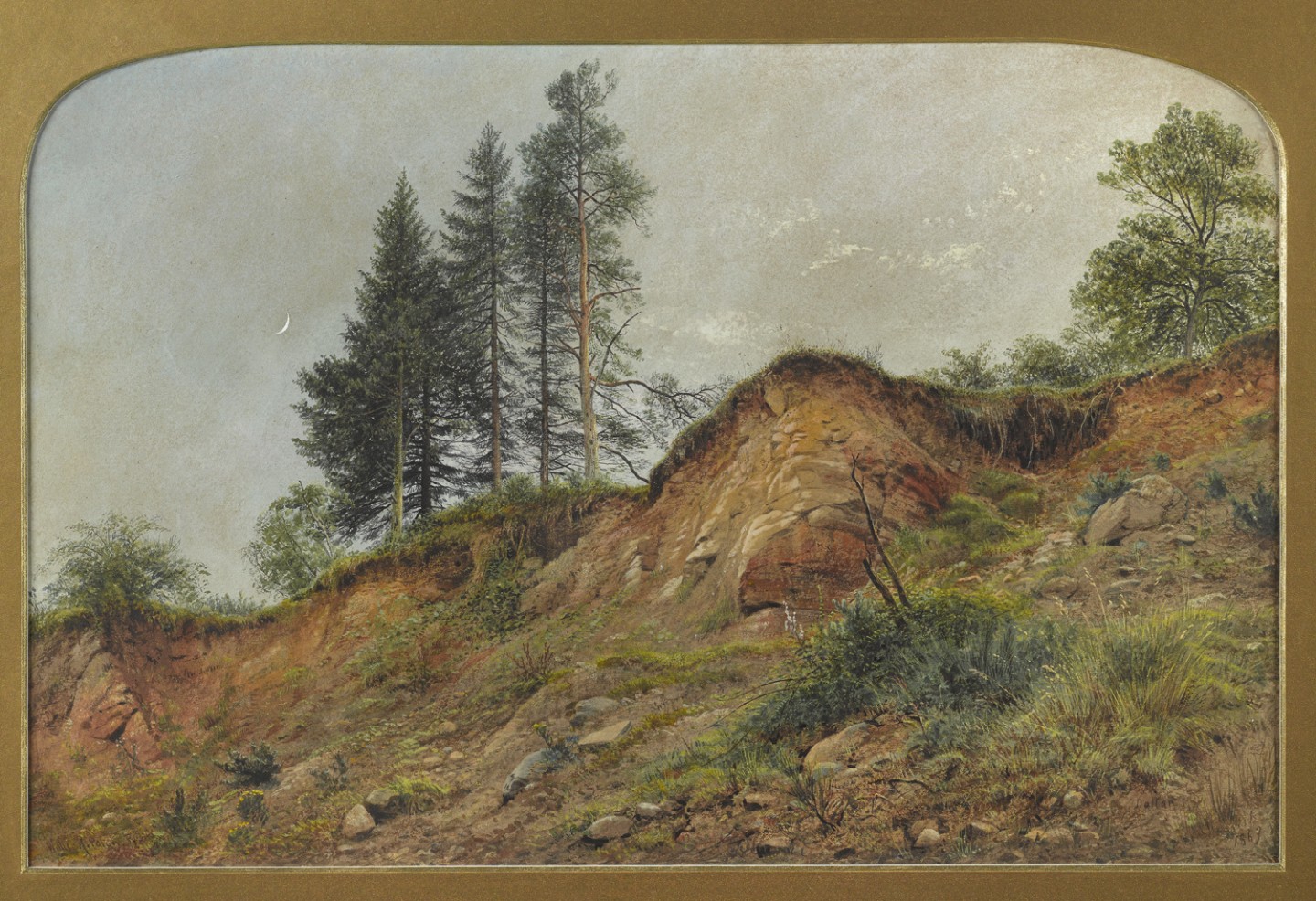
Dollar by Waller Paton (1828-1895) captures a rocky hillside landscape from a lower viewpoint, looking up towards the ledge with small groupings of trees making up the background. Paton uses small, precise flecks of watercolour to build up a realistic level of detail throughout the work, in natural tones of colour. Within the sky, Paton employs a slightly wetter technique, blending light blue with an overwash of grey. Part of the paint was not allowed to seep into the paper, allowing a sliver of a crescent moon to be seen on the left side of the work.
Paton's level of detail in this work and delicate paint strokes are reflective of a romantic way to capture landscapes, characteristic of landscapes produced during the time period. Paton's work largely focused on landscapes, and other works by him often had a rounded top edge in framing.
DETAILS
-
Artist
Waller Paton
-
Date
1869
-
Medium
Watercolour on paper
-
Object number
733
-
Dimensions unframed
34.2 × 52.1 cm
-
Dimensions framed
62 × 80 cm
-
Marks
Signed bottom right
-
Subject
ARTIST PROFILE
Waller Hugh Paton RSA RSW, 1828-1895
Paton was born in Dunfermline, Fife, the brother of the painter Sir Joseph Noel Paton and the sculptress Amelia Hill. He studied briefly and with John Adam Houston, but was largely self-taught; the art theories of John Ruskin and of the Pre-Raphaelites greatly influenced him. A prolific artist, he concentrated almost exclusively on landscape in oil and watercolour. Nearly all his landscapes are Scottish, although he visited the English Lake District several times.