
Boy with a Turkey
Edward Gage


DESCRIPTION
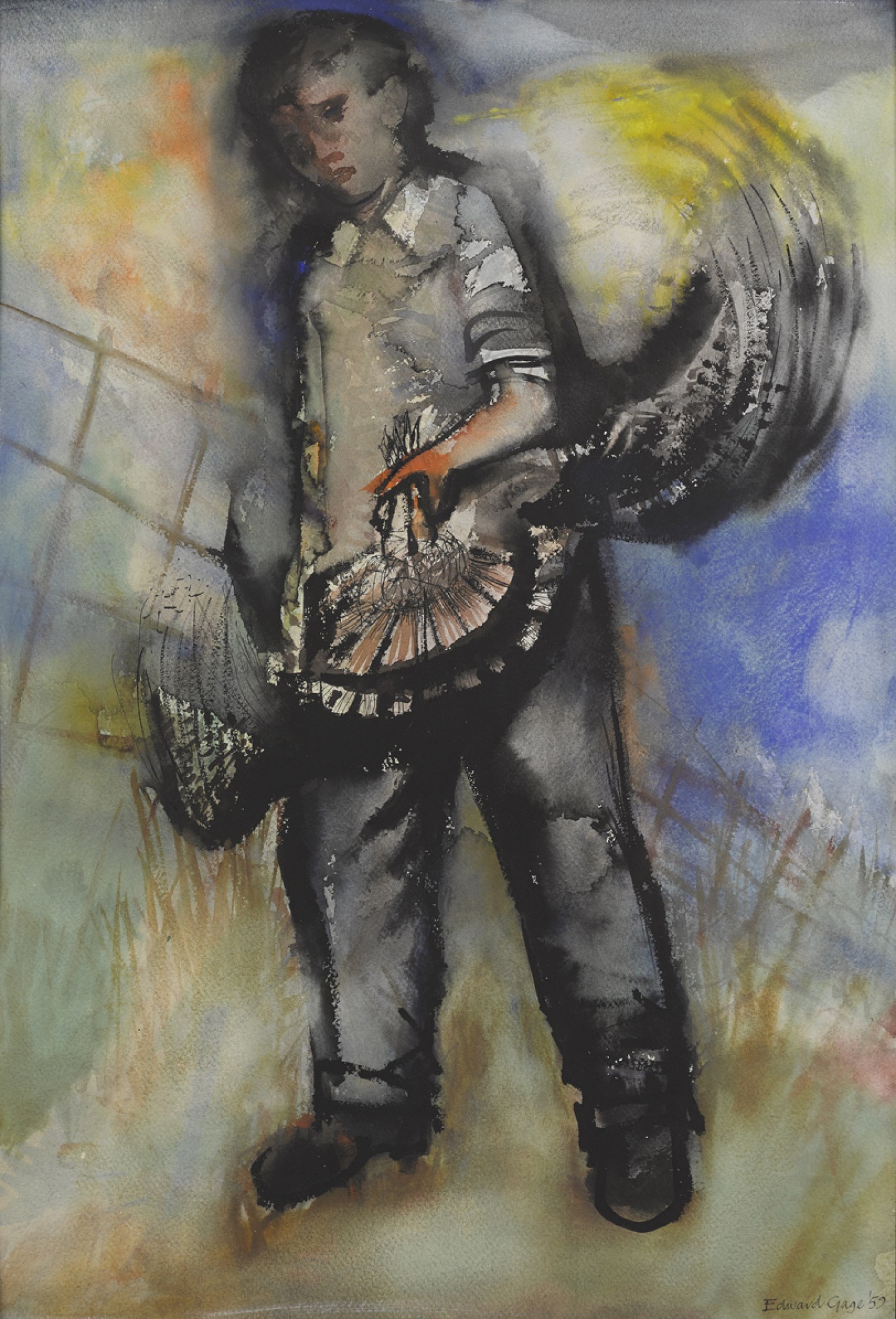
Boy with a Turkey by Edward Gage (1925-2000) depicts a young boy holding a turkey by the legs. Gage uses thick sweeping strokes of black to create the turkey's wings, with the first layer of these watered down and then placing drier strokes on top, to create movement with the turkey as though the boy is swinging it or the bird is struggling to break free. Thin lines of brown amid the final lines of black detail closest to the boy's hand show the turkey's flexed tail. The boy is captured in looser detail, with watered down black watercolour making up his clothes and slightly mixed with the watered down red of his skin. Gage went back in with thicker strokes of solid watercolour to outline the boy against the softer background and to create the boys sorrowful expression. The background's colour is blended together with Gage having wet the page, loosely capturing a fence in quick lines of brown. The pops of colour with blue, yellow, and orange add to the active energy of the painting, contrasting with the boy's expression of concern.
DETAILS
-
Artist
Edward Gage
-
Date
1959
-
Medium
Watercolour on paper
-
Object number
347
-
Dimensions framed
97 × 73 cm
-
Marks
Signed and dated bottom right
-
Subject
-
Copyright
Ⓒ The Copyright Holder
ARTIST PROFILE
Edward Gage, 1925-2000
Born in Gullane, East Lothian, Gage studied at Edinburgh College of Art, although his studies were disrupted by military service during World War II. A travelling scholarship enabled him to spend time in Mallorca in 1950, where the poet Robert Graves was a neighbour. Back in Edinburgh, he became art master at Fettes College, a post he held for 17 years, then becoming a lecturer at Napier College (now Napier University) for 12 years. From 1966-1995, he was art critic for the Scotsman, and produced a book on contemporary painting, The Eye of the Wind, in 1977. Gage designed stage sets and produced illustrations for magazines but painting was his first love, and he exhibited regularly, producing mainly watercolours often inspired by Mediterranean travel.