
Scottish Art News
Latest news
Magazine
News & Press
Publications
Kate Bentley: Conversations with Hornel
By Susan Mansfield, 05.10.2026
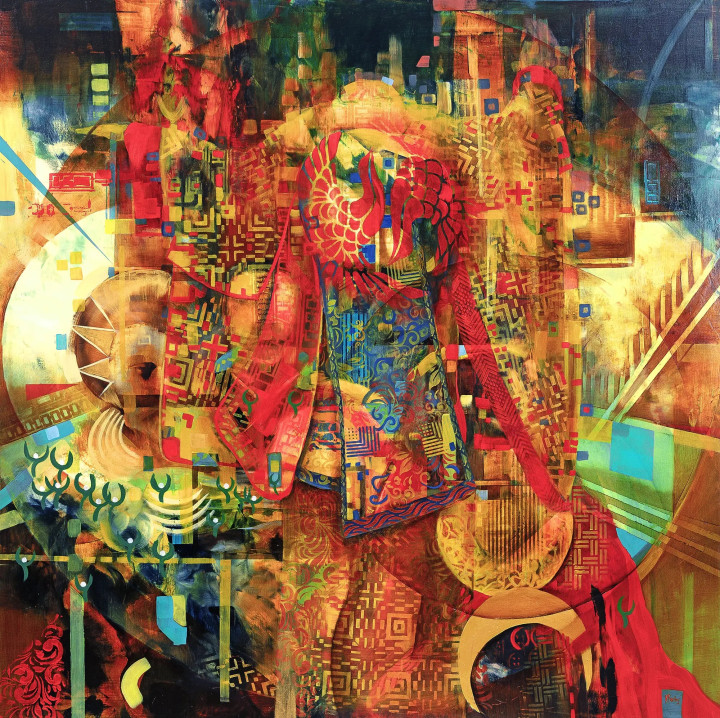
Ever since she moved to Kirkcudbright five years ago, artist Kate Bentley found herself being asked about Edward Atkinson Hornel (1864 – 1933). “Because I use a lot of Japanese themes in my paintings, people kept asking me if I was inspired by him,” she says. “And the answer was always ‘no’!”
However, she became ever more intrigued by the painter, a contemporary of the Glasgow Boys, best known for his pictures of children and gardens and his fascination with Japan where he spent two extended visits. His home, Broughton House, a fine 18th-century townhouse and garden in Kirkcudbright, is managed by the National Trust for Scotland as a museum to his life and work.
Visiting the house and garden “planted a seed” in Bentley’s head for a project engaging with Hornel and his work in a series of paintings. She had created a similar project some years before while living in Cumbria, spending time in the house and gardens at Brantwood, the home of John Ruskin. Her new body of work, Conversations with Hornel, which is on display at the Whitehouse Gallery in Kirkcudbright emerged from a period as artist-in-residence at Broughton House.
“I was keen to deal with another artist and their home and be inspired by their work and their surroundings and their influences,” she says. “It felt like Hornel and I connected on lots of levels. He was interested in Japan, as I am, he had a collection of blue and white pottery, as I do. The garden is beautiful, and I am a keen gardener.”
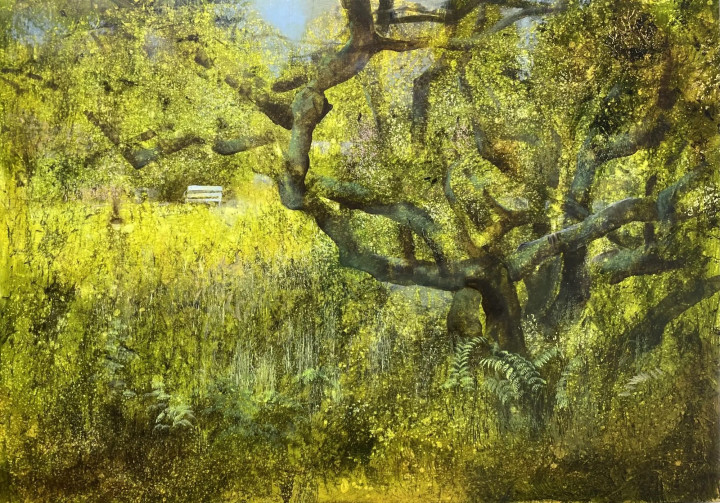 Kate Bentley. Hornel’s Garden. Courtesy of The Whitehouse Gallery. © The Artist.
Bentley, who trained as a sculptor and worked as a theatre designer before becoming a full-time painter in 1999, creates multi-layered paintings which sit between representation and abstraction. Working on as many as 30 pictures at any given time, she adds and removes, working with textures and glazes, allowing images to emerge or suggest themselves. Her interests include colour, pattern, costume and the human figure, all of which, incidentally, she shares with Hornel.
For some works, she decided to draw directly from Hornel paintings, sketching the composition and blocking in areas of colour as an underpainting for her own work. “I saw the project as an artistic challenge: to step inside Hornel’s creative world and continue our visual conversation there. Each painting became a mental wrestling match. I was determined not to revisit the original work, allowing each painting to evolve into its own narrative while maintaining a dialogue with Hornel’s work, ultimately finding its own independent voice.”
Her greatest tussle was with ‘The Druids Bringing in the Mistletoe’ (1890), her favourite of his paintings, a collaboration between Hornel and George Henry on a Celtic revival theme, which is in the collection at Kelvingrove Museum. “It was incredibly difficult not to keep returning to what Hornel had originally painted, which is an indicator that it’s a really strong composition,” she says.
“After a very frustrating two months I decided to turn the whole piece upside-down and painted the interior of Hornel’s Broughton House studio over it thinly in glazes. Once I’d done this, I broke the spell of his dominance and was able to have some insight as to the direction that I wanted to go!”
The finished painting, ‘Conversations with Hornel’, the title piece of her show, is not a homage or a copy, but the abstracted traces of the original composition are present. The shapes of the Druid figures are joined by the back view of a woman in a kimono - also a perfect fit with Hornel.
Other paintings in the series refer directly to the house and garden, and also draw on Hornel’s extensive archive of photographs and documents - including kimono catalogues - which he used as references for his own paintings. “The interior of the house is a feast for the eyes, I had to rein myself in and be selective, choosing just a few rooms to focus on.” ‘The Exhibition Room’, for example, draws on Hornel’s Exhibition Room, which has a frieze inspired by the Parthenon marbles and glass display cabinets which cause an interplay of layered reflections. Hornel’s self portrait emerges, ghostly, from among the colours. Another painting, ‘Presence’ is inspired by the Dining Room in Broughton House, and Hornel’s painting, ‘A Galloway Idyll’.
.oil on panel.84x60cm.frame 75x99cm.£3500.jpg) Kate Bentley. Presence (The Galloway Idyll). Courtesy of The Whitehouse Gallery. © The Artist.
Several focus on the garden, which Hornel extended by buying the garden of the house next door, and which was also influenced by his love of Japan. The house itself, which is painted pink, is the colourful backdrop in paintings such as ‘Cherry Blossom Pink’.
Bentley suspects she might not yet be finished with Hornel. I might even go back and do part two, because there’s a lot in the house that you could build on and develop. I spent just a short time with his archives, but you could spend weeks and weeks if you wanted to.”


