Trigidia
Mary Newbery Sturrock


DESCRIPTION
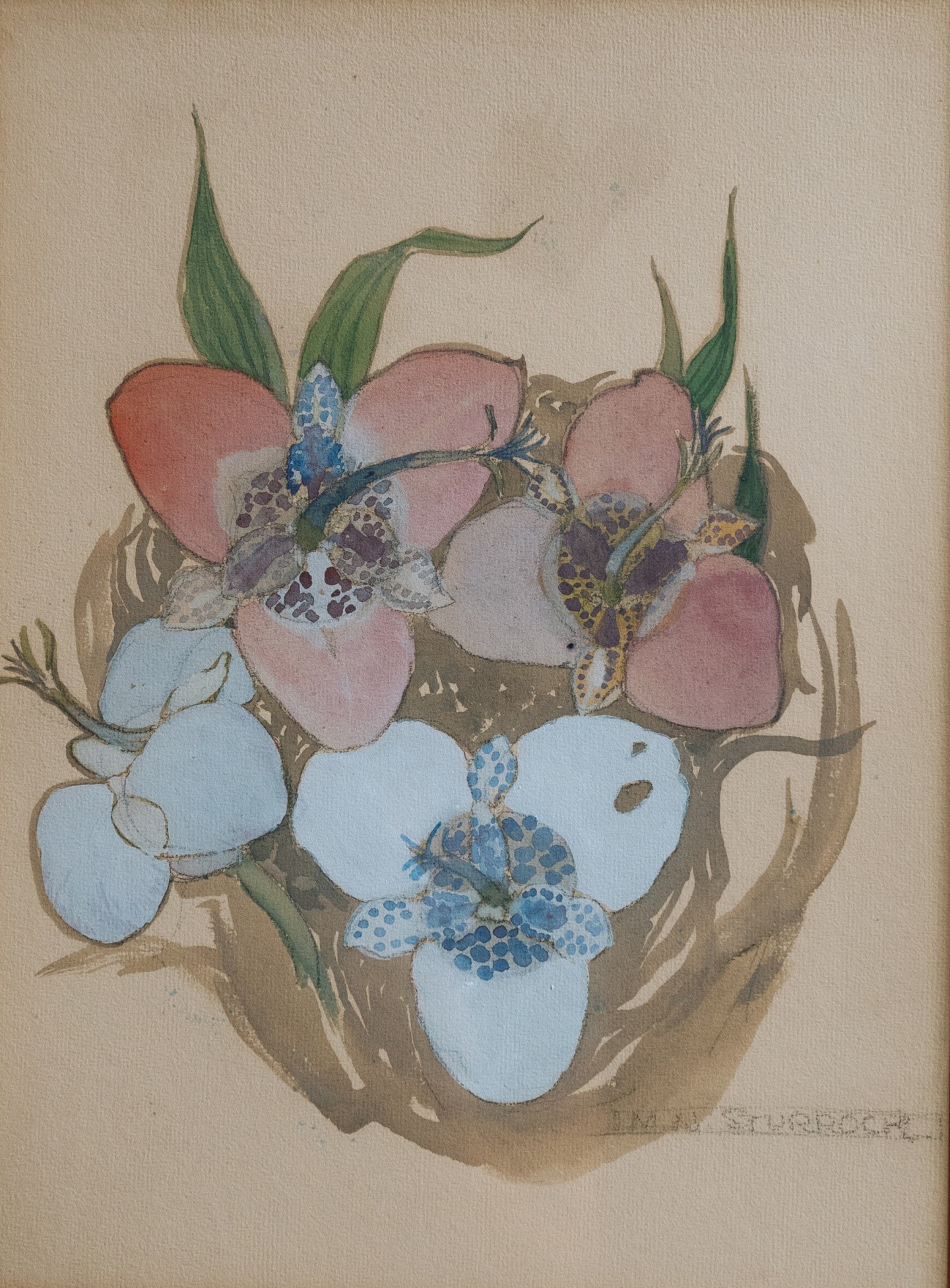
Trigidia by Mary Newbery Sturrock (1892-1985) contains four flowers, three from an aerial perspective, one pointed away from the viewer. Their petals contain one solid form of colour, with each spotted detail also containing one colour tone. This creates a flattened sense of depth in the piece, with only some dimensionality present in the presence of shadows being painted beneath the flowers with sweeps of washed out brown colour against the tan background.
The focus of this work is on the patterns and petal shape of the Tigridia flower, unique for its flat petal structure and spot patterned centres. Sturrock specialised in botanical illustration while at school, present here in the precise way she captures the structure of the flower and its colour tones, although true blue tigridia's are not known than the usual red and yellow varieties, suggesting Sturrock created this false colour from a white tigridia flower.
DETAILS
-
Artist
Mary Newbery Sturrock
-
Date
1920s
-
Medium
Mixed media on paper
-
Object number
3239
-
Dimensions unframed
37 × 27 cm
-
Dimensions framed
53.6 × 42.6 × 2 cm
-
Marks
Signed bottom right
-
Subject
-
Copyright
Ⓒ The Copyright Holder
ARTIST PROFILE
Mary Newbery Sturrock, 1892-1985
When she was six years old, Sturrock carried the ceremonial key for the opening of the Mackintosh building at Glasgow School of Art, which had been commissioned by her father, the School’s director, Francis Newbery. She would later study there, specialising in embroidery, as her mother Jessie had, and botanical illustration. Sturrock was a close friend of the artist Cecile Walton and her husband Eric Robertson; one of Walton’s major early paintings is of Eric and Mary. She became close to Charles Rennie Mackintosh during the First World War when he lived near the Newberys in Walberswick, and drew and painted flowers alongside him. She also worked in ceramics, ink drawing and embroidery.